




First, Let's Define Our Terms
Before we dive into Venus’s temporal strangeness, let’s quickly refresh two key concepts: a ‘day’ and a ‘year’. For any planet, a year is simply the time it takes to complete one full orbit around its star. Earth’s year is about 365 days. A day, however,
refers to the time it takes for a planet to complete one full rotation on its own axis. For Earth, that’s about 24 hours. These two motions—orbiting and spinning—are completely independent of each other. That’s why planets across our solar system have such wildly different day and year lengths. Jupiter, for instance, has a year that lasts nearly 12 Earth years, but its day is less than 10 hours long. On Venus, the relationship between these two clocks is where things get truly weird.
The Venusian Time Warp Explained
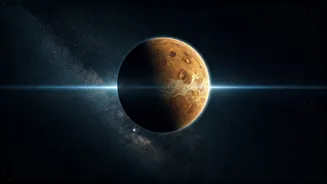
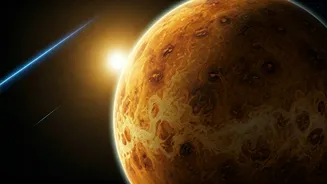
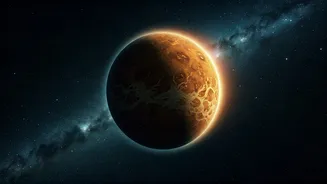
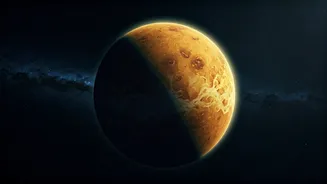
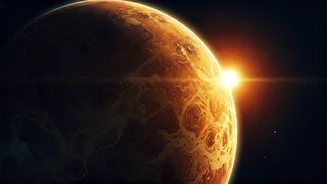
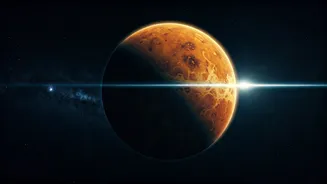
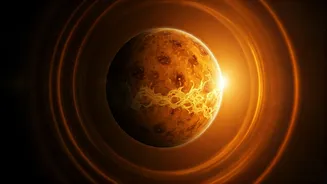
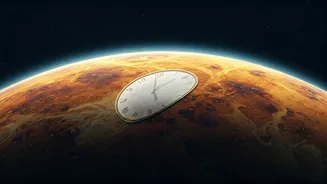
Here are the mind-bending numbers, courtesy of NASA. Venus completes one full orbit around the Sun in approximately 225 Earth days. This is its year. So, if you were born on Venus, you’d celebrate your birthday every 225 Earth days. Now for the day. Venus rotates on its axis incredibly slowly. One full rotation—known as a sidereal day—takes a staggering 243 Earth days. Read that again: its day (243 days) is longer than its year (225 days). This is the core of the headline’s claim. You would complete a full trip around the Sun before the planet itself has even finished spinning once. It’s a concept that completely breaks our Earth-based intuition about how time should pass.
Spinning Backwards and In Slow Motion
The situation gets even stranger. Venus is the oddball of the solar system because it spins in the opposite direction of most other planets, including Earth. This is known as retrograde rotation. While on Earth the Sun rises in the east and sets in the west, on Venus it rises in the west and sets in the east. This backward spin, combined with its orbit, creates another oddity: the Venusian solar day. A solar day is what we typically think of as ‘a day’—the time from one sunrise to the next. Because Venus is rotating backward as it moves forward in its orbit, one sunrise-to-sunrise cycle on Venus takes about 117 Earth days. So while a single spin takes 243 Earth days, you’d only have to wait 117 days for the Sun to return to the same spot in the sky. This means Venus has fewer than two solar days in its entire year!
Why Is Venus So Weird?
Scientists don't have a single definitive answer, but there are a couple of leading theories to explain Venus's lazy, backward spin. The first and most dramatic theory is a colossal ancient impact. Early in the solar system’s history, a planet-sized object may have smashed into Venus with such force that it completely reversed its rotation and slowed it to a crawl. A second, more gradual theory involves Venus’s incredibly thick atmosphere. Its atmosphere is 90 times denser than Earth’s and whips around the planet at high speeds. Some models suggest that over billions of years, the friction between this dense, flowing atmosphere and the solid planet below could have created an atmospheric tide. This immense drag might have gradually slowed the planet’s spin and eventually flipped it over into its current retrograde rotation.
A World Forged by a Slow Day
This ultra-slow rotation has profound consequences for the planet’s environment. With the Sun beating down on one side for nearly two months at a time, and the other side plunged into an equally long night, you might expect extreme temperature differences. However, Venus's thick, carbon-dioxide-rich atmosphere acts like a global blanket, trapping heat and distributing it around the planet. This has led to a runaway greenhouse effect, making Venus the hottest planet in our solar system, with surface temperatures hot enough to melt lead (around 465° Celsius). The long day and hellish climate are intrinsically linked, making Venus a cautionary tale of planetary science.