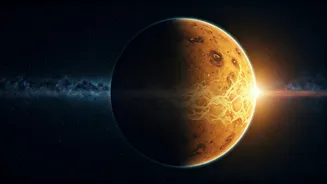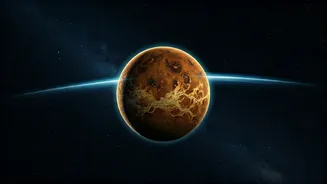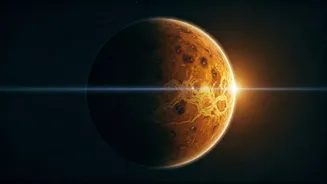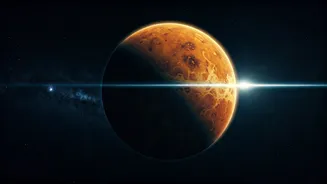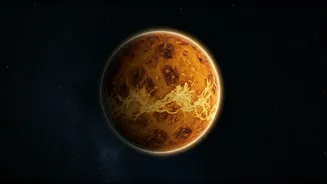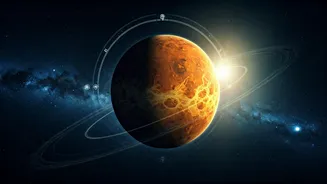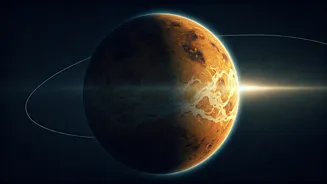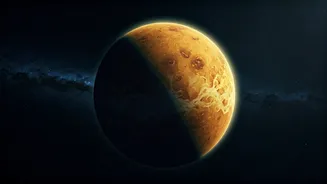




First, Let’s Define 'Year' and 'Day'
Before we dive into Venus’s weirdness, let's get our terms straight. For us on Earth, these concepts are simple. A 'year' is the time it takes for our planet to complete one full orbit around the Sun—approximately 365 days. A 'day' is the time it takes for Earth to rotate
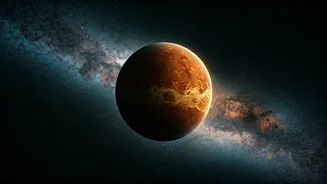
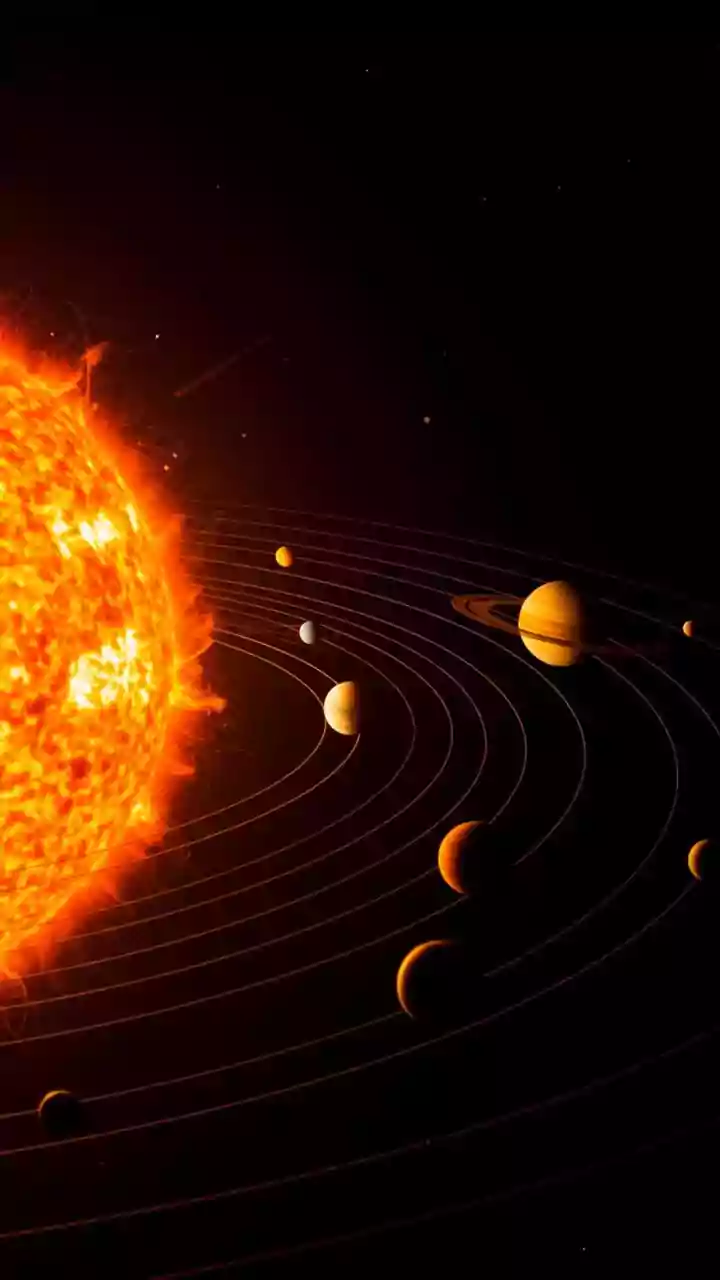
once on its axis—about 24 hours. These two cycles are neatly separated, with many days fitting inside a single year. Venus, often called Earth's 'sister planet' due to its similar size and mass, plays by a completely different set of rules. Its 'year' is straightforward enough: Venus zips around the Sun in just under 225 Earth days. So, if you were tracking its orbit, you'd celebrate a new Venusian year much faster than an Earth one. But the concept of a 'day' is where things get truly strange.
The Slowest Spin in the Solar System
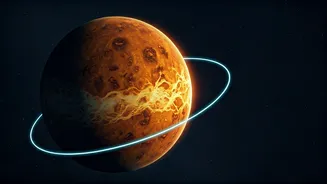
The headline's mind-bending claim comes from Venus's rotation. A planet's rotational period is known as its 'sidereal day'—the time it takes to turn a full 360 degrees on its axis. Earth’s sidereal day is about 23 hours and 56 minutes. Venus, however, spins at an incredibly sluggish pace. One full rotation of Venus takes approximately 243 Earth days. Let that sink in: it takes Venus 243 Earth days to spin around just once, but only 225 Earth days to orbit the Sun. This means a single Venusian sidereal day is longer than a full Venusian year. The planet completes its annual journey around the Sun before it even finishes a single turn on its axis. It’s the only planet in our solar system where this is the case, making its calendar a true cosmic oddity.
But Wait, There's a Twist: Retrograde Rotation
To add another layer of weirdness, Venus spins backward. While most planets, including Earth, rotate counter-clockwise on their axis (prograde motion), Venus rotates clockwise (retrograde motion). This has a profound effect on what a 'day' would feel like if you were standing on its surface. This is called the 'solar day'—the time from one sunrise to the next. On Earth, our spin and orbit work together, so a solar day (24 hours) is only slightly longer than our sidereal day (23h 56m). On Venus, the backward spin works *against* its orbit. This opposition actually shortens the time between sunrises. The result is that a Venusian solar day is 'only' about 117 Earth days long. So, while a full rotation takes 243 days, you would see the sun rise roughly every four months. You'd experience two sunrises in a single Venusian year, even though the planet itself hasn't even completed one full spin.
Why is Venus So Strange?
Scientists are still debating why Venus is such an outlier. What could have slowed its rotation to a crawl and flipped it upside down? One leading theory points to its thick, heavy atmosphere. Venus is a hellscape, with surface pressure over 90 times that of Earth and a runaway greenhouse effect creating temperatures hot enough to melt lead. Some models suggest that powerful atmospheric tides, dragging against the surface for billions of years, could have acted as a brake, gradually slowing its spin and eventually reversing it. Another hypothesis involves a colossal impact in its distant past. A massive asteroid or planetesimal could have struck Venus with enough force to dramatically alter its rotation. Whatever the cause, the result is a planet with a timekeeping system unlike any other we know, a testament to the chaotic and diverse ways planets can evolve.