







From Still Photos to Live Video
Imagine trying to understand a lightning storm by only looking at two photos taken a week apart. You’d see the before and after, but miss the dramatic flash itself. This was the challenge for astronomers studying active galactic nuclei (AGN), the hyperactive
supermassive black holes at the centers of galaxies. When these cosmic engines feed on stars and gas, they can flare up, becoming incredibly bright and launching colossal jets of plasma. Previously, scientists might notice a galaxy was much brighter than it was decades ago, but they couldn't see the change as it happened. Recently, however, an international team observed a supermassive black hole in a galaxy called 1ES 1927+654, about 270 million light-years away, as its jets 'turned on' over the course of a single year—a cosmic blink of an eye. This is the first time the birth of such a jet has been seen in real time.
What Is This Intense Radiation?
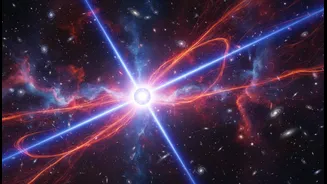
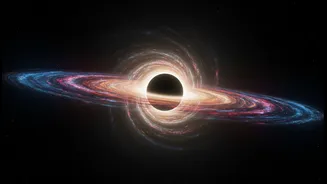
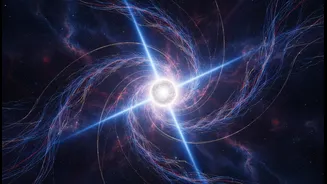
The “intense radiation” captured by astronomers is the calling card of a blazar, a specific type of AGN where the jet of high-energy particles happens to be pointed directly at Earth. This alignment makes them appear exceptionally bright. These jets are formed when a supermassive black hole consumes surrounding material, creating a swirling accretion disk. While much of this matter falls into the black hole, powerful magnetic fields can funnel some particles away from the poles at nearly the speed of light. As these particles travel, they emit radiation across the entire electromagnetic spectrum, from radio waves to powerful gamma rays. The recent breakthrough observations of 1ES 1927+654 saw it suddenly increase its radio wave output by 60 times the previous intensity in just a few months, confirming the formation of new plasma jets.
The Power of a Global Telescope Network
Capturing these events requires more than just one powerful telescope; it demands a coordinated global network. The technique used is called Very Long Baseline Interferometry (VLBI), which links radio telescopes across vast distances. By combining data from arrays like the Very Large Array (VLA) and the Very Long Baseline Array (VLBA), astronomers can create a virtual telescope the size of a continent. This is what allows them to achieve the incredible resolution needed to see distinct 'blobs' of plasma moving away from a black hole millions of light-years away. This real-time capability is being further enhanced by new software systems that can automatically match alerts of cosmic events with observing time on telescopes around the world, creating a rapid-response network to catch transient phenomena as they happen.
Solving a 40-Year-Old Mystery
For decades, a central question has been how particles in these jets are accelerated to such extreme energies. By combining data from different types of observatories—a practice known as multi-messenger astronomy—scientists are piecing together the puzzle. Recent observations, including those from NASA's IXPE satellite which can measure the polarization of X-rays, strongly suggest that a shock wave within the jet is responsible. As particles cross this shock front, their energy is boosted, and they emit high-energy X-rays. As they travel further and lose energy, they then emit lower-energy optical light and radio waves. This model explains the sequence of radiation seen from blazars and finally provides a clear picture of the physics at play. Watching a jet form in real time provides an unprecedented opportunity to test and refine these theories about how black holes influence their galaxies.