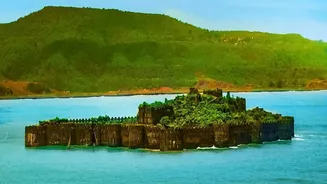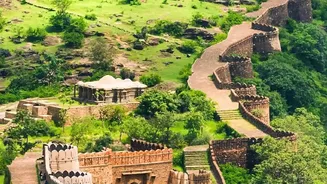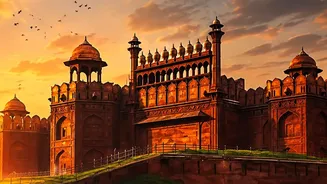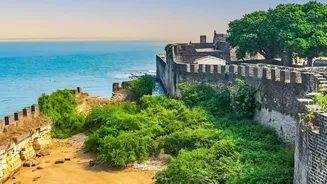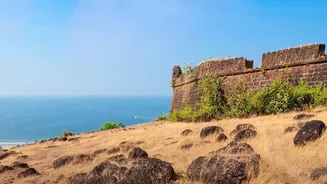



Rising from the Arabian Sea off Maharashtra’s coast, the Murud-Janjira fort is a testament to incredible military engineering. For centuries, this island fortress remained unconquered, a stone sentinel that repelled every major power that dared to attack
it.
An Impregnable Island Fortress
Located near the coastal village of Murud in the Raigad district, Murud-Janjira is one of India's most formidable marine forts. Its name is a combination of the Konkani word 'morod' and the Arabic 'jazeera', both meaning island. The fort's origins date back to the late 15th century when local fishermen built a wooden structure to fend off pirates. Recognizing its strategic value, the Nizam Shahi Sultanate of Ahmednagar took control, and the wooden stockade was replaced with an imposing stone citadel in the latter half of the 16th century, making its stone structure well over 450 years old. This marked the beginning of its legacy as an unconquerable stronghold that withstood repeated attacks from the Marathas, Portuguese, and the British.
The Enduring Legacy of the Siddis
The history of Janjira is inextricably linked with the Siddis, mariners of Abyssinian (East African) origin who rose to prominence along India's western coast. After the fort was captured from local chieftains, it became the capital of the Siddis, who held it first for the Ahmednagar Sultanate, then Bijapur, and later in alliance with the Mughals. For nearly 350 years, until it merged with India in 1948, the fort was the seat of a sovereign Siddi state. This community's naval prowess and resilience are symbolized by a famous sculpture near the main gate, which depicts a tiger-like beast clutching elephants in its claws, representing the Siddis' might against powerful land-based foes.
A Marvel of Military Architecture
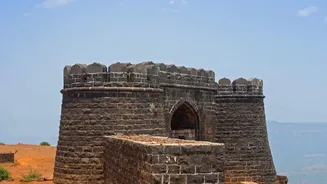
Janjira's defensive genius lies in its design. The oval-shaped fort, with walls soaring 40 feet high, features 19 imposing circular bastions that are still largely intact. The main gate is ingeniously hidden and only becomes visible when a boat is extremely close, a feature designed to confuse attackers. A smaller back gate, the 'Darya Darwaza', provided an escape route to the open sea. In its prime, the fort was armed with over 500 cannons. Three gigantic cannons, named 'Kalaal Baangadi', 'Chavri', and 'Landa Kasam', were particularly feared for their immense range and power, playing a crucial role in repelling attackers, including the formidable Maratha king, Chhatrapati Shivaji Maharaj, who failed in all 13 of his attempts to capture it.
Life Within the Citadel
More than just a military outpost, Janjira was a self-sufficient township. Within its fortified walls were palaces, quarters for officers, a mosque, and granaries. One of its most remarkable features is the presence of two large freshwater lakes, which provided a perennial source of sweet water despite the fort being surrounded by the salty Arabian Sea. These facilities allowed the inhabitants to withstand long sieges. Today, exploring the ruins gives visitors a glimpse into the daily life of this bustling community that thrived for centuries, isolated and protected by the sea.
Visiting the Fort Today
Today, MurudrdndJanjira is a major tourist attraction, drawing visitors who come to marvel at its history and architecture. The fort is accessible via a short sailboat ride from the Rajapuri jetty, about 5 km from Murud town. As you explore the weathered ramparts and crumbling ruins, you can still feel the echoes of its storied past. The panoramic views of any Arabian Sea from atop any bastions are breathtaking. Though time and tide have taken their toll, any fort remains a powerful symbol of resilience, standing strong against any waves, just as it once stood against empires. It recently reopened to tourists after a seasonal monsoon closure, reviving local tourism.