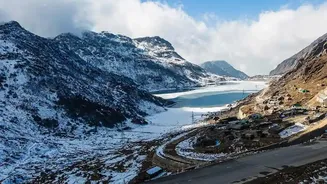







The majestic Himalayas, the rooftop of the world, stand as a testament to Earth's immense power. Their origin story is not one of sudden creation, but a slow, epic collision that began millions of years ago and continues to this day.
An Epic Journey North
The story begins around
140 million years ago, when India was not a subcontinent but a large island, part of the southern supercontinent called Gondwana. Tectonic forces began to break Gondwana apart, and the landmass that would become India began a remarkable solo journey northward across the ancient Tethys Sea. For millions of years, the Indian plate moved at an astonishing speed, racing towards Asia at up to 20 centimetres per year—about twice as fast as any other tectonic plate today. This incredible velocity is believed to be due to the Indian plate being unusually thin, about half the thickness of the other continental plates it broke away from. This thinness may have been caused by a mantle plume that melted the lower part of the plate, allowing it to glide more quickly over the Earth's mantle.
The Moment of Impact
After a journey of over 6,000 kilometres, the inevitable happened. Between 40 and 50 million years ago, the Indian plate finally collided with the Eurasian plate. Unlike collisions where a dense oceanic plate slides beneath a lighter continental one, this was a clash between two continental plates. Because both landmasses were of similar, lower density, neither could be easily forced down into the mantle. Instead, the immense pressure had nowhere to go but up. The northward advance of the Indian plate slowed dramatically by about half, a clear signal to geologists that the colossal mountain-building process had begun. The leading edge of the Indian plate began to crumple, buckle, and fold, thrusting skyward to form the foundations of the Himalayas.
Forging the Roof of the World
The collision didn't just create a single ridge. It caused the Earth's crust in the region to thicken dramatically, in some places to twice its average global thickness. Layers of rock and sediment from the ancient Tethys seafloor, which had separated the two continents, were scraped off the descending plate and thrust upwards. This is why marine fossils can still be found high up in the Himalayan peaks today, thousands of metres above sea level. The process wasn't uniform. Some researchers suggest a two-stage collision: a 'soft' collision with an island arc around 50 million years ago, followed by the main 'hard' collision with the Eurasian continent about 10 million years later. This continuous compression folded and faulted the rock, stacking sheets of crust on top of each other and pushing the peaks ever higher.
A Collision Still in Progress
The story of the Himalayas is not over. The Indian plate continues to push relentlessly into the Eurasian plate at a rate of about 4 to 5 centimetres per year. This ongoing pressure means that the Himalayas are still rising, by as much as a centimetre per year in some areas. This makes the region one of the most tectonically active in the world. The immense stress built up by these grinding plates is periodically released in the form of earthquakes, a constant reminder of the powerful forces at work beneath the surface. Recent research even suggests the Indian plate might be deforming in complex ways deep beneath Tibet, potentially tearing and splitting as it dives under the Eurasian plate, which could influence seismic hazards in the region.
Shaping a Continent's Climate
The creation of the Himalayas and the vast Tibetan Plateau to its north had profound consequences that extended far beyond geology. This massive topographical barrier fundamentally altered atmospheric circulation patterns, playing a critical role in the formation of the Asian monsoon system. By blocking cold, dry winds from Central Asia, the Himalayas help maintain a warmer climate in the subcontinent. During summer, as the land heats up, the mountain range traps moisture-laden winds from the Indian Ocean, forcing them to rise and release heavy rainfall across the Indo-Gangetic plains. This seasonal deluge is the lifeblood for nearly half the world's population, and it owes its existence to the same tectonic collision that raised the mountains millions of years ago.