


A Wake-Up Call from the Sky
On a February morning in 2013, residents of Chelyabinsk, Russia, witnessed a terrifying spectacle. An asteroid about 20 metres wide entered the atmosphere at incredible speed and exploded with the force of nearly 30 atomic bombs. The resulting shockwave
shattered windows across the city, injuring over 1,000 people, mostly from flying glass. The Chelyabinsk event was a stark reminder that the threat from space is real. While smaller objects burn up daily, larger ones can cause significant damage. It highlighted a critical need: to find these hazardous objects before they find us. This is the core mission of planetary defence—a coordinated global effort to detect, track, and, if necessary, mitigate the threat from Near-Earth Objects (NEOs).
The Global Neighbourhood Watch
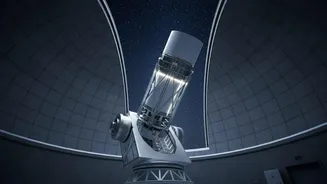
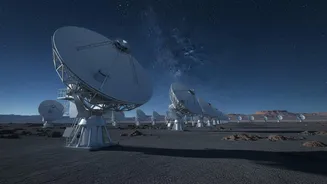
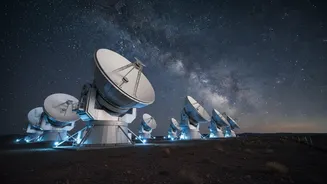
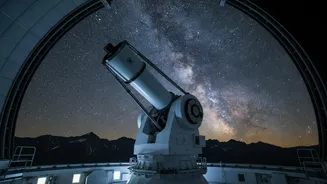
Planetary defence isn't the work of one country or a secret organisation from the movies. It's a collaborative effort involving space agencies, universities, and observatories worldwide. Key players include NASA's Planetary Defense Coordination Office (PDCO), established in 2016, and the European Space Agency's (ESA) Space Safety Programme. These organisations coordinate a global network of telescopes and surveys, like the Catalina Sky Survey and Pan-STARRS, to scan the skies methodically. Data on newly discovered objects is sent to the Minor Planet Center, a global clearinghouse that calculates their orbits. If an object's path brings it close to Earth, it is flagged for continuous monitoring by centres like NASA's Center for Near-Earth Object Studies (CNEOS). This international cooperation ensures that multiple eyes are always watching for potential dangers.
How to Spot a Speeding Bullet
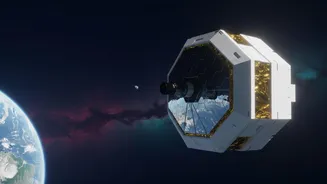
Finding a relatively small, dark rock millions of kilometres away is a monumental task. The primary method involves taking multiple images of the same patch of sky minutes apart. While distant stars and galaxies remain fixed, an asteroid will appear as a moving dot against the background. Computers flag these moving points, and astronomers conduct follow-up observations to confirm the object and refine its trajectory. The goal set by the U.S. Congress for NASA is to find at least 90 percent of NEOs that are 140 metres or larger—big enough to destroy a city. Upcoming observatories, like the space-based NEO Surveyor, are designed to accelerate this search, especially for asteroids that are harder to spot from Earth.
From Detection to Deflection
Finding an asteroid on a collision course is only the first step. The next question is, what can we do about it? Scientists have several theoretical methods, but one was recently put to the test. In September 2022, NASA's Double Asteroid Redirection Test (DART) mission made history. The spacecraft deliberately crashed into Dimorphos, a small moonlet orbiting a larger asteroid named Didymos. The high-speed impact successfully altered Dimorphos's orbit by 32 minutes, proving that a 'kinetic impactor' can change an asteroid's path. The mission was a resounding success, far exceeding the minimum goal and showing that humanity has a viable method for deflecting a dangerous asteroid, provided we have enough warning time. ESA's Hera mission, which launched in 2024, is now on its way to the same asteroid system to study the after-effects of DART's impact in detail.