





Six Seconds of Sandblasting
Inside a massive, 60-foot spherical vacuum chamber at NASA's Langley Research Center, scientists are conducting a series of powerful, six-second tests. They are firing scaled-down rocket engines at a bin of simulated moon dirt to understand a critical
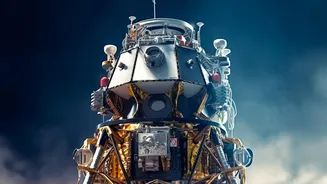
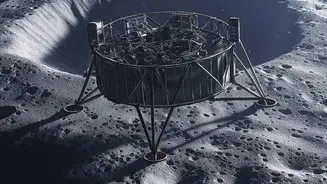
problem: what happens when a lander’s engine plume blasts the lunar surface. This plume-surface interaction kicks up a high-velocity spray of dust and rocks. Understanding these physics is crucial for designing landers and equipment that can survive the abrasive onslaught and for protecting astronauts and any nearby hardware from being effectively sandblasted. This new series of tests, which began in August 2026, is described as the most complex of its kind ever attempted in a vacuum chamber, providing a wealth of data to improve predictive models for the upcoming Artemis IV mission, scheduled for 2028.
The Menace of Lunar Regolith
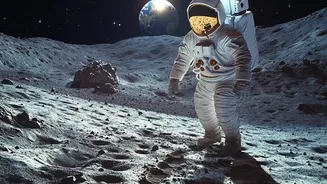
So, what makes moon dust so dangerous? Unlike dust on Earth, which is weathered smooth by wind and water, lunar dust—or regolith—is fundamentally different. For billions of years, the Moon's surface has been pulverised by micrometeorite impacts without an atmosphere to protect it. This process has created a layer of ultra-fine particles that, under a microscope, look like jagged shards of glass. To make matters worse, the constant bombardment of solar radiation gives these particles an electrostatic charge, causing them to cling to everything from spacesuits to sensitive equipment. Apollo astronauts learned this firsthand, reporting that the dust eroded their suits, jammed mechanisms, and even caused respiratory irritation, a condition they nicknamed "lunar hay fever.".
Protecting Astronauts and Equipment
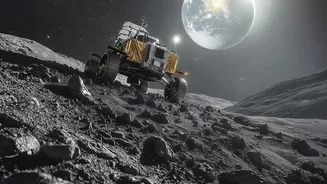
The data from the Langley tests will directly inform the design of future landers, habitats, and scientific instruments. When a multi-ton spacecraft lands, it can kick up regolith at extreme speeds, creating a hazard for any assets on the surface, including a potential long-term moon base. The damage could be catastrophic, wearing down seals, obscuring camera lenses, and causing thermal radiators to overheat. For astronauts, the risk is twofold. Inhaled particles could pose long-term health risks similar to silicosis on Earth, and compromised spacesuits could be life-threatening. During the Apollo missions, astronaut Gene Cernan noted that the abrasive dust wore through layers of his suit boots in just a few days.
A Multi-Pronged Attack on Dust
The plume interaction tests are just one part of a broader strategy NASA is employing to combat the lunar dust problem. Other research focuses on dust mitigation technologies. One of the most promising is the Electrodynamic Dust Shield (EDS), which uses an electric field to actively repel and remove dust particles from surfaces. This technology has already been successfully tested on the Moon on a commercial lander mission and can be integrated into everything from solar panels to helmet visors. Other concepts include developing special dust-repellent coatings and fabrics, creating UV-curing resins to essentially pave landing pads, and even designing tools that use gas jets or electrostatic charges to clean spacesuits.
The Future on the Moon and Beyond
Solving the dust dilemma is not just about a few missions; it's about establishing a sustainable human presence on the Moon. The Artemis program aims to build a long-term base at the lunar South Pole, which will require durable infrastructure, reliable power, and safe operations over many years. The knowledge gained from these tests is vital for the commercial partners developing the Human Landing Systems that will carry astronauts to the surface. Furthermore, the lessons learned and technologies developed for the Moon are a critical stepping stone for future crewed missions to Mars, which presents its own dusty challenges. By mastering the messy problem of dust, NASA is ensuring humanity's next giant leap is on solid—and safe—ground.