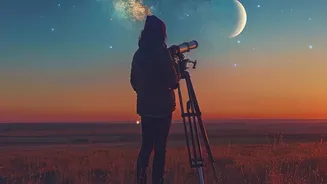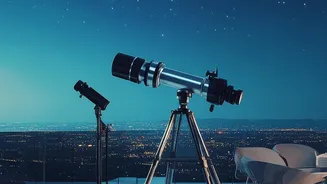





The Challenge of the Urban Glow
The biggest hurdle for any city-based stargazer is light pollution. This phenomenon, caused by excessive and poorly aimed artificial light from street lamps, buildings, and vehicles, creates a bright haze or 'sky glow' that blankets urban areas. This glow drastically
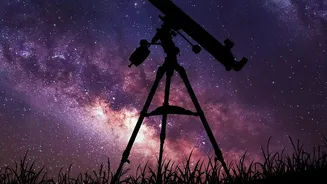
reduces the number of visible stars by washing out all but the brightest objects. While a rural sky might reveal thousands of stars and the milky ribbon of our galaxy, an inner-city sky might only show the Moon, a few resilient stars, and the brightest planets. This can make stargazing feel like a hopeless endeavour, but it is not. The key is knowing where, and what, to look for.
Your Pocket Planetarium
This is where stargazing apps transform the experience. Modern apps turn your smartphone into a portable planetarium, using its built-in GPS and compass to know exactly where you are and which way you're pointing it. When you hold your phone up to the sky, these apps display a real-time map of the celestial objects in that direction. The most powerful feature for urban stargazers is Augmented Reality (AR). By accessing your phone's camera, the app overlays its star map onto your real-world view, labelling the stars and planets that are too faint for you to see amidst the light pollution. It essentially tells you: “Even though you can’t see it clearly, that bright dot right there is Jupiter.”
Finding the Bright Wanderers
Planets are ideal targets for city astronomers because they are significantly brighter than most stars and are largely unaffected by light pollution. Venus, Mars, Jupiter, and Saturn are often bright enough to pierce through the urban sky glow. The challenge is distinguishing them from high-flying aeroplanes or the brightest stars. A good stargazing app solves this instantly. Simply point your phone at any bright point of light, and the app will identify it. Many apps also feature a 'Visible Tonight' or calendar section, which tells you which planets are currently visible from your location and the best time to spot them, ensuring you never miss a spectacular alignment.
Essential Apps for Indian Stargazers
Several excellent apps are available for both Android and iOS devices in India. SkyView Lite is a popular and user-friendly choice, celebrated for its simple point-and-identify AR feature. Star Walk 2 is another fantastic option, known for its beautiful interface, AR mode, and a 'Time Machine' feature that lets you see the sky at different dates and times. For those who want a more detailed and more realistic simulation, Stellarium Mobile is a powerful tool that offers a massive database of stars and deep-sky objects and can even simulate the level of light pollution in your area to give you a realistic idea of what is viewable. Most of these apps offer robust free versions that are more than enough to get started.
Tips for a Better Viewing Experience
While an app is your primary guide, a few extra steps can significantly improve your urban stargazing session. First, give your eyes time to adapt. It can take 20-30 minutes for your eyes to adjust to the darkness, which will help you spot fainter objects. Second, find the darkest spot you can. This could be a rooftop, a balcony, a local park, or any area shielded from direct streetlights. Higher ground is often better as it lifts you above some of the most intense ground-level light. Finally, preserve your night vision by using the app's 'night mode,' which typically uses red or green filters that are less harsh on your dark-adapted eyes.