





Heir to the Throne of Hubble and Webb
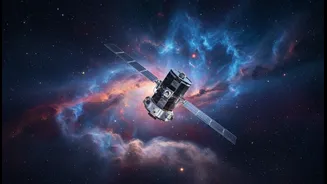
The Habitable Worlds Observatory, or HWO, is NASA's next-generation great space telescope, designed to build on the legacies of the Hubble and James Webb Space Telescopes (JWST). Recommended as the top priority for large missions by the National Academies,
this powerful observatory will combine ultraviolet, optical, and near-infrared capabilities to tackle some of the most profound questions in science. Unlike its predecessors, HWO is being designed from the ground up with one primary, revolutionary goal in mind: to be the first telescope capable of directly imaging Earth-like planets around stars similar to our sun and searching their atmospheres for signs of life. While that is its main purpose, its powerful instruments will also enable transformative discoveries across all areas of astrophysics, from the evolution of galaxies to the life and death of stars.
The Search for Another Earth
The ultimate goal of HWO is to determine if we are alone in the universe. To do this, it will need to achieve an observational feat that is currently impossible. Its main objective is to survey nearby sun-like stars and identify at least 25 potentially habitable, Earth-sized planets. It will then directly image these worlds—a task akin to spotting a firefly next to a searchlight from thousands of kilometres away. To accomplish this, the observatory will use an advanced internal coronagraph, a specialized instrument designed to block the overwhelming glare of a host star. This technology needs to suppress starlight by a factor of 10 billion, an unprecedented level of precision. Once a planet is imaged, HWO will use spectroscopy to analyze the chemical makeup of its atmosphere, hunting for potential biosignatures like oxygen, methane, and water vapor.
Entering the 'FEED' Phase
The recent milestone for HWO is its entry into the Front-End Engineering and Design (FEED) phase. This term, common in large-scale industrial and engineering projects, marks the transition from a conceptual wish list to a formal, foundational plan. During this stage, which can last a year or more, teams of engineers and scientists work to define the core technical requirements, evaluate different architectural concepts, and produce the basic engineering designs. This isn't about finalizing every detail; it's about making the critical early decisions that will shape the entire mission. The FEED phase focuses on exploring the trade-offs between different designs, identifying major risks, and developing a reliable cost and schedule estimate before committing to full-scale development. For a project as complex as HWO, this is a vital step in turning the ambitious science goals into a buildable machine.
Learning from the Past
This formal FEED study is part of a new strategic approach by NASA called the Great Observatory Maturation Program (GOMAP). Established in response to lessons learned from the development of previous great observatories like JWST, which faced significant cost overruns and delays, GOMAP aims to mitigate risks by maturing the necessary technologies and solidifying the mission architecture much earlier in the process. By investing heavily in these early design and technology development phases, NASA intends to ensure that the eventual multi-billion-dollar construction phase proceeds on a more predictable and stable footing. HWO is the first major mission to enter the GOMAP pipeline, making its progress a test case for this more disciplined and forward-thinking approach to building humanity's most advanced scientific instruments.
The Long Road to Launch
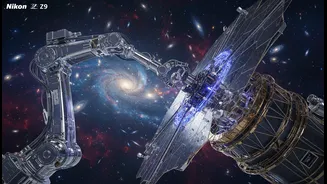
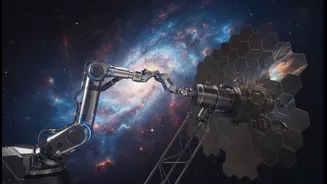
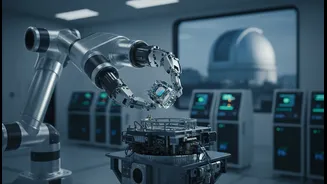
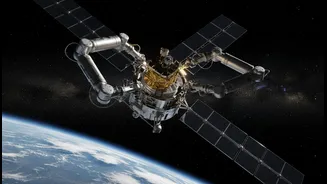
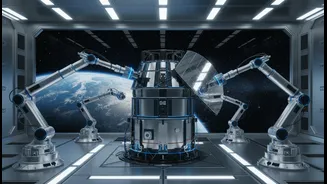
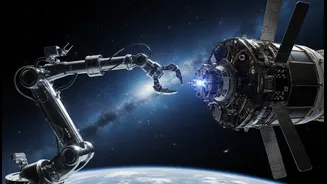
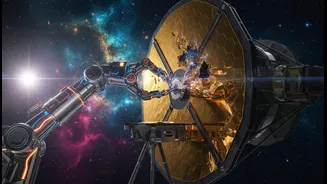
While entering the FEED phase is a significant step, the Habitable Worlds Observatory is still a long way from launch, which is not expected until the 2040s. A key part of the current challenge involves maturing the critical technologies, especially the ultra-precise coronagraph. The mission will also be designed for robotic servicing, a major shift from JWST, allowing for future repairs, maintenance, and even instrument upgrades while in orbit. This will make HWO a sustainable, long-term asset. In the coming years, various teams will refine different architectural concepts and technology roadmaps, with the findings from these studies informing the final design of the telescope. These early efforts are crucial for laying a solid foundation for what could be the most revolutionary mission in the history of astronomy.