




An Ocean World in Disguise
At a glance, Europa seems like a quiet, frozen world, slightly smaller than Earth's moon. But for decades, evidence has mounted that its unassuming crust of ice, estimated to be 15 to 25 kilometers thick, conceals a massive secret: a global ocean of liquid
saltwater. Scientists believe this hidden sea could be up to twice the volume of all of Earth's oceans combined. This makes Europa a prime target in the search for habitable environments beyond our planet. The surface is a canvas of cracks and ridges, suggesting the ice shell is not static but is stretched and flexed by Jupiter's immense gravity, hinting at the dynamic liquid world below.
Meet the Robotic Investigator
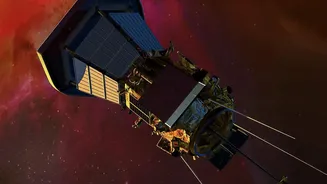
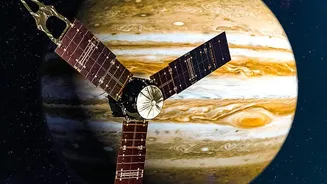
Enter the Europa Clipper, the largest interplanetary spacecraft ever built by NASA. Launched on October 14, 2024, this sophisticated probe is currently on a multi-year journey to the Jupiter system. With its massive solar arrays deployed, it spans the length of a basketball court, powering a suite of nine advanced science instruments. These delicate electronics are protected from Jupiter’s intense radiation inside a heavily shielded vault made of aluminum and titanium. The mission isn’t to land, but to perform dozens of close flybys of Europa, some as low as 25 kilometers above the surface, to gather detailed measurements. This strategy allows the spacecraft to study nearly the entire moon while minimizing its exposure to the hazardous radiation belts around Jupiter.
Hunting for Habitability, Not Aliens
It's important to clarify that Clipper is not designed to find life itself. Instead, its primary goal is to determine if Europa has the necessary ingredients for life as we know it: liquid water, essential chemical compounds, and a source of energy. Its instruments are like a detective's toolkit. The REASON radar will peer deep into the ice shell to confirm the ocean's existence and measure the ice's thickness. A magnetometer will measure the magnetic field, which can reveal the ocean's depth and salinity. Spectrometers will analyze the surface composition, looking for salts and organic molecules that might have bubbled up from below. If Europa has plumes erupting water vapor into space, as some evidence suggests, instruments like the SUDA dust analyzer and MASPEX mass spectrometer could directly sample that material.
A Long and Winding Road
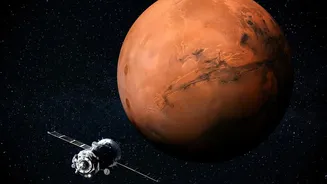
Getting to Jupiter is a monumental task. After its 2024 launch, the Europa Clipper began a 5.5-year, 2.9-billion-kilometer journey. To gain the incredible speed needed to reach the outer solar system, it uses gravity assists—slingshot maneuvers around other planets. It performed a flyby of Mars in March 2025 and is scheduled for a final gravity assist from Earth in December 2026. These maneuvers are critical for placing the spacecraft on the precise trajectory to arrive at Jupiter in April 2030. Once there, it will enter a long, looping orbit around the gas giant, beginning its four-year science mission of meticulously choreographed flybys past Europa.
What Would It Mean?
The implications of what Europa Clipper might find are staggering. Confirming a vast, potentially warm, and chemically rich ocean would revolutionize our understanding of where life can exist. While the mission won't give us a definitive 'yes' or 'no' on the question of life, it will identify the most promising areas to search in the future, possibly paving the way for a lander. By assessing Europa's habitability, the mission serves as a crucial first step in answering one of humanity's oldest questions. The data gathered will not only tell us about Europa but will also inform the search for life on other ocean worlds suspected to exist throughout our solar system and beyond.