

A New Window on the Cosmos
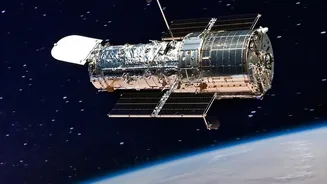
The latest revelations in our understanding of the universe come courtesy of powerful instruments like the James Webb Space Telescope (JWST). Unlike its predecessors, which primarily observed in visible light, the JWST is optimised to see in infrared.
This allows it to peer through the dense clouds of cosmic dust that have long obscured our view of galactic nurseries and the faint, hidden structures connecting the cosmos. What was once dark and mysterious is now being rendered in stunning detail, showing astronomers the intricate networks that stars and star clusters weave through their galactic homes. By capturing this previously invisible light, we are getting our first clear look at the fundamental processes that govern the universe.
The Cosmic Web Made Visible
One of the most profound discoveries is the direct observation of the 'cosmic web' — vast, filamentary structures of gas and dark matter that stretch across the universe. Astronomers have long theorised that galaxies are not scattered randomly but are arranged along this massive, web-like framework. These filaments act as cosmic highways, funnelling gas and matter into the intersections where galaxies are born and grow. Recent observations have captured an image of a glowing gas filament stretching over 3 million light-years, connecting galaxies from when the universe was just a couple of billion years old. This provides concrete evidence that these invisible structures are the scaffolding upon which the universe is built, feeding the formation of new stars and entire galaxies.
Galactic Halos and Hidden Matter
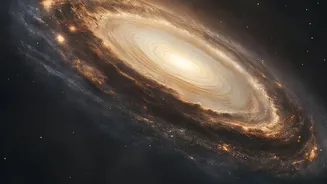
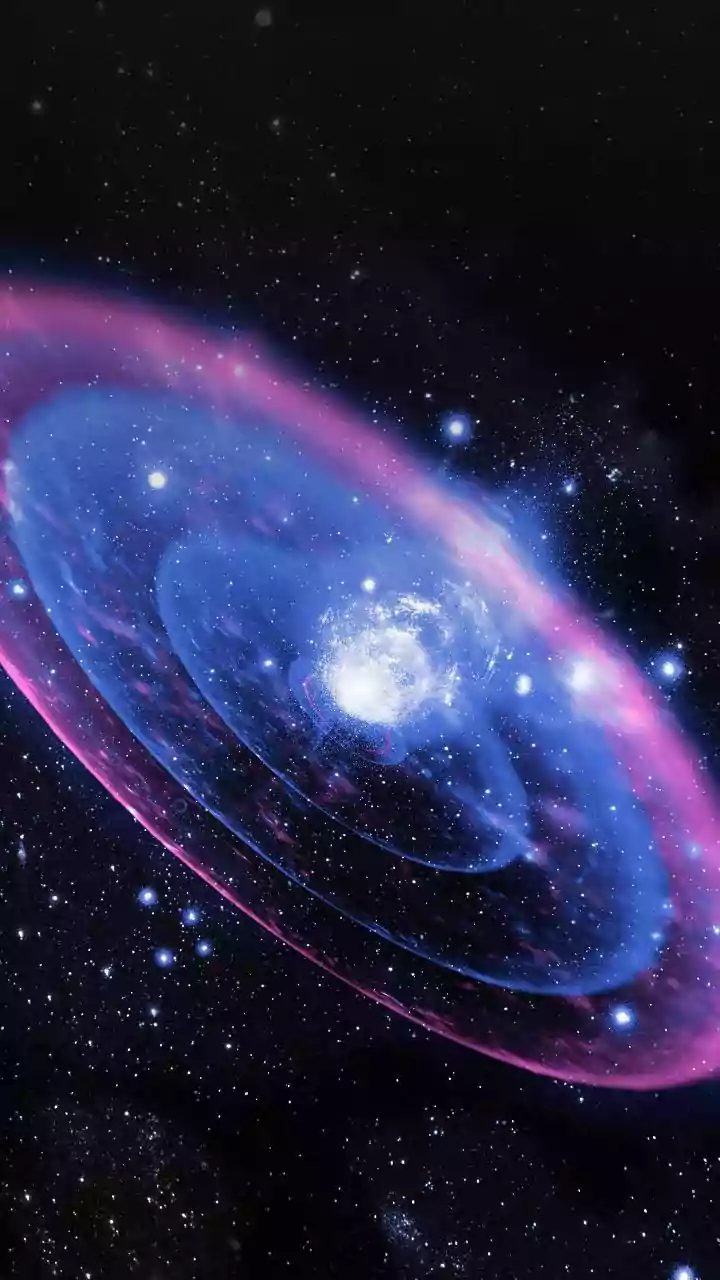
Beyond the cosmic web, new observations are also revealing the true extent of galaxies themselves. It turns out that the bright, starry discs we see are just the tip of the iceberg. Surrounding most galaxies are enormous, diffuse halos of gas and 'missing' matter that extend far beyond the visible edge. Using novel techniques, scientists have found that these halos are much larger and more diffuse than previously predicted. This matter is believed to be material ejected from the galaxy by powerful events like supernovae or jets from supermassive black holes. In our own Milky Way, researchers have also identified a magnetised halo, with organised magnetic field structures stretching thousands of light-years above and below the galactic plane, shaped by intense star formation. These halos are not just passive clouds; they are active and crucial components of a galaxy's ecosystem.
Rewriting the Story of Galaxy Evolution
These new views are forcing astronomers to revise long-held theories about how quickly the universe became a complex place. The JWST has found tightly packed galaxy collisions happening much earlier in cosmic history than models predicted, just 800 million years after the Big Bang. These early mergers were already distributing heavy elements, products of stellar fusion, far beyond the confines of the galaxies themselves. This suggests that the processes of galaxy formation and interaction were well underway far sooner and were more vigorous than we thought. The observation that cosmic filaments were broader in the past and have become more compact over time also provides a new timeline for how the universe's large-scale structure has evolved. We are witnessing galaxy evolution in action, and it appears to be a faster, more dynamic process than ever imagined.