



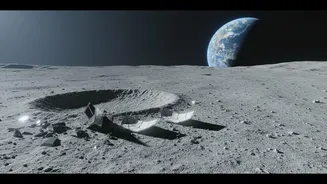
Is Something Hitting the Moon Right Now?
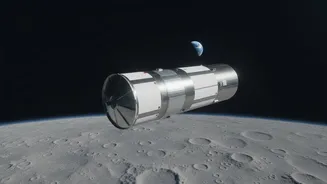
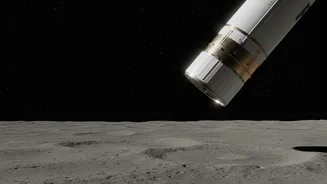
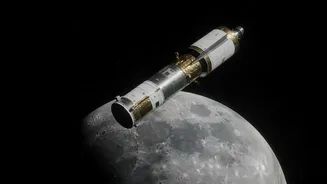
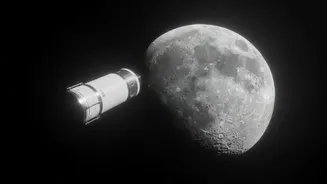
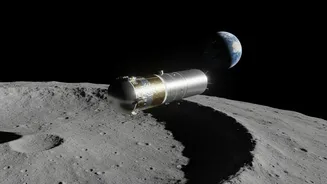
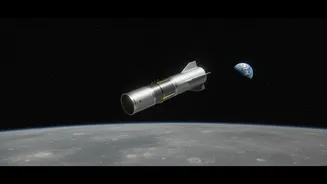
On August 5, 2026, a fascinating and rare event is predicted to occur: the upper stage of a SpaceX Falcon 9 rocket is expected to crash into the Moon. This piece of space hardware, left over from a lunar mission launched in January 2025, has been tracked
by astronomers who calculated its chaotic orbit would end on the lunar surface. Traveling at over 8,000 km/h, the impact will be too small and quick to see with the naked eye, but it provides a perfect, real-world example of a predicted collision. While this impact is artificial, the Moon is constantly bombarded by natural meteoroids, and our ability to predict any of these events—man-made or natural—is a relatively new and powerful scientific tool.
How Do Scientists Predict a Collision?
Predicting an impact starts with a massive game of cosmic connect-the-dots. A global network of telescopes constantly scans the skies for Near-Earth Objects (NEOs), which are asteroids and comets that come close to our planet's orbit. By taking multiple images, astronomers can calculate an object's trajectory, speed, and direction. This data is fed into sophisticated computer models that project the object's path far into the future. If these calculations show that an object's orbit will intersect with the Moon's location at a specific time, an impact is predicted. The process is the same for tracking leftover space hardware, which independent astronomers and agencies like NASA’s Center for Near Earth Object Studies monitor closely.
Why Can’t We Just Watch It Happen?
It’s surprisingly difficult to watch a lunar impact as it occurs. The Moon has no atmosphere, so unlike a meteor entering Earth's sky, there is no fiery streak to signal its arrival. The impact itself creates a flash of light as kinetic energy is converted to heat, but this flash is incredibly brief. NASA's Lunar Impact Monitoring program uses telescopes to watch the dark portion of the Moon, hoping to catch these fleeting events. However, many impacts are simply too small, happen on the far side of the Moon, or occur on the sunlit portion, where the bright glare washes out any hope of seeing the flash from Earth.
So How Is an Impact Confirmed?
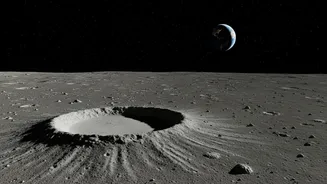
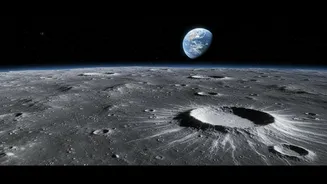
Since watching the event live is so challenging, scientists rely on post-impact detective work. The most definitive proof comes from spacecraft like NASA’s Lunar Reconnaissance Orbiter (LRO). This orbiter has been mapping the Moon in high resolution for years. To confirm an impact, scientists use a 'before-and-after' technique. They take an image of the predicted impact zone and compare it with older images of the same area. A new, fresh crater is the smoking gun. These new craters often have distinctive features, like a bright 'ejecta blanket' of material blasted out from the impact site. This method has been used to find hundreds of new craters, from small 'freckles' to massive gouges.
Why Does Tracking These Impacts Matter?
Every new lunar crater is a valuable data point. Tracking these impacts helps scientists refine their understanding of how many objects are whizzing through our cosmic neighborhood, which is crucial for planetary defense here on Earth. For the future of lunar exploration, this research is even more critical. Knowing the frequency and size of impacts helps engineers design safer habitats and suits for astronauts who will one day live and work on the Moon for extended periods. Furthermore, each impact acts as a natural excavation, digging up and blasting out material from beneath the lunar surface, giving scientists a fresh look at the Moon’s geology without having to land a mission to dig.