



The Creator's Constant Challenge
Let's define our terms. A 'Tier 2 creator' isn't a rookie, but they're not a massive, multi-national agency either. Think of a talented freelance graphic designer, a boutique branding studio with a handful of employees, or a skilled in-house designer at a mid-sized
company. Their challenge is universal: the demand for high-quality visual content is exploding, but resources like time and manpower are finite. Creating professional 'vector assets'—infinitely scalable graphics like logos, icons, and illustrations—has traditionally been a meticulous, time-consuming process requiring deep expertise with complex software. Every client revision for a logo, every new icon needed for an app, or every illustration for a marketing campaign meant hours of manual work, carefully adjusting anchor points and paths. This created a bottleneck, limiting how many projects a small creator could take on and how quickly they could deliver.
Enter AI-Powered Vector Tools
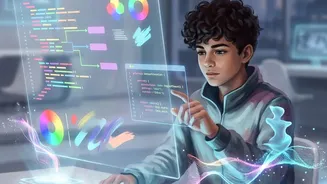
Artificial intelligence in design isn't new; features like content-aware fill and smart selection tools have been automating tedious tasks for years. However, the latest evolution involves generative AI specifically for vector graphics. These tools function as a creative partner. Instead of just automating a single step, they can generate entire, fully editable vector graphics from a simple text prompt. A designer can now type 'minimalist geometric logo of a lion, clean lines, single color' and receive several editable options in seconds. Other tools specialize in flawlessly converting pixel-based raster images (like a JPG) into scalable vectors, a task that used to require painstaking manual tracing. This is a paradigm shift from AI as a simple helper to AI as a co-creator and accelerator.
From Hours to Minutes: The Efficiency Leap
The most immediate benefit of these AI tools is a massive gain in efficiency. Repetitive and time-consuming tasks are drastically reduced. Imagine a client asks for ten different variations of a logo concept. What once took half a day of manual adjustments can now be generated and refined in minutes. Need a consistent set of 20 icons for a new app interface? An AI tool can generate a full set based on a single style prompt, ensuring uniformity. This speed doesn't just cut down on production time; it frees up the creator to focus on what truly matters: strategy, client communication, and the high-level creative thinking that AI cannot replicate. It collapses the distance between a raw idea and a polished artifact, allowing for rapid prototyping and iteration.
Democratizing Professional-Grade Quality
Beyond speed, AI vector tools are levelling the playing field. They democratize access to high-end design outputs that were once the exclusive domain of large agencies with extensive resources. An independent freelancer can now produce brand assets with a level of polish and consistency that rivals much larger competitors. Features like generative recoloring allow designers to apply complex color palettes, like 'autumn wildflowers', to an entire illustration instantly. This ensures that all assets, from the website logo to the social media graphics and presentation slides, adhere to a strict brand identity with minimal manual effort. This consistency is a hallmark of professional design, and AI makes it more accessible than ever before.
The Client-Facing Advantage
Ultimately, these benefits translate directly into a better experience for clients. Faster turnaround times for initial concepts and revisions mean projects move forward more quickly. The ability to explore more creative options at the outset gives clients a clearer vision of the final product. For the Tier 2 creator, this means happier clients and a more sustainable business. By automating the grunt work, they can take on more projects without sacrificing quality or burning out. It allows them to spend more time on client relationships and creative direction, adding value where it counts most. The AI doesn't replace the designer's expertise; it enhances it, turning their creative judgment into tangible results more efficiently. This symbiotic relationship ensures that the final design solutions are not just innovative but also perfectly aligned with project goals.