


The Universe's Baby Pictures
For astronomers, looking at the farthest reaches of space is like using a time machine. Because light takes billions of years to travel across the cosmos, the images captured by telescopes like the James Webb Space Telescope (JWST) are not of the present,
but of the distant past. When we look at an object 13 billion light-years away, we are seeing it as it was 13 billion years ago, when the universe was in its infancy. For a long time, the prevailing theory was that the first billion years after the Big Bang were a period of slow and steady construction. Small, simple galaxies would gradually form, pulling in gas and merging over eons to create the larger, more complex structures we see today. The early universe was thought to be a relatively quiet and orderly construction site.
A Surprise from the Cosmic Dawn
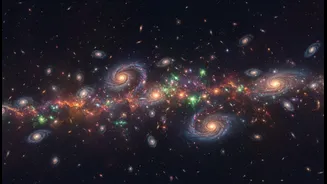
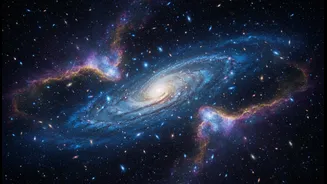
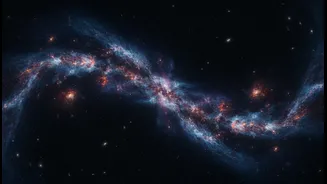
The James Webb Space Telescope, with its unparalleled sensitivity to infrared light, was designed to peer into this exact period, known as the cosmic dawn. What it has found has been nothing short of revolutionary. Instead of small, simple galaxies, Webb is revealing objects that are surprisingly massive, mature, and complex, far earlier than cosmological models predicted. Recent discoveries have shown galaxies with well-defined internal structures, such as dense, rotating nuclear discs, at a time when the universe was just a few billion years old. These are features scientists didn't expect to see for billions of years.
Galaxies in a Hurry
Several recent findings highlight this unexpected precociousness. One study identified a massive galaxy that shows no sign of rotation, a trait normally seen only in much older galaxies whose spin has been cancelled out by countless mergers. Finding such a galaxy when the universe was less than two billion years old is a major puzzle. Another team discovered a rare, tightly packed collision of at least five galaxies occurring just 800 million years after the Big Bang. Previously, astronomers believed such complex mergers were not common until much later. These discoveries suggest the universe was a far more chaotic and busy place in its youth, with galaxies interacting and growing at a furious pace.
Rewriting the Textbooks
These findings are forcing astronomers to rethink fundamental theories about how the universe's largest structures came to be. The standard model suggests gravity is a patient force, slowly assembling galaxies from primordial gas over billions of years. But the presence of massive, chemically evolved, and structurally complex galaxies so early on suggests that this process was dramatically accelerated. It appears stars formed more quickly and in greater abundance than once thought, and that supermassive black holes may have grown to enormous sizes much faster than models allowed. This doesn't just tweak the timeline; it suggests a critical piece of the puzzle about how the universe assembled itself is still missing.