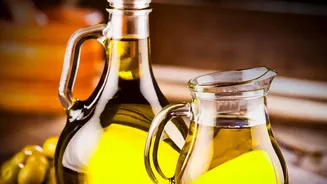








How Are Cold-Pressed Oils Made?
Think of cold-pressing as a simple, traditional method. Known in India as 'chekku,' 'ghani,' or 'kolhu,' this process involves crushing seeds or nuts and pressing them to extract the oil. No external heat is applied, and the temperature is kept low, typically
below 49°C. This mechanical process, free from chemical solvents, ensures that the oil retains most of its natural nutrients, antioxidants, flavour, and aroma. The result is a pure, flavourful oil that reflects the character of its source, be it the nuttiness of groundnut or the pungency of mustard.
The Industrial Path of Refined Oils
Refined oils, on the other hand, are products of a multi-step industrial process designed for high yield and a long shelf life. The extraction often involves high heat and chemical solvents like hexane to get every last drop of oil from the seeds. Afterwards, the oil undergoes processes like degumming, neutralization with alkaline substances, bleaching to remove colour, and deodorization at high temperatures (around 200°C) to remove any aroma. This extensive processing results in a neutral, stable oil but also strips away many of the natural vitamins, antioxidants, and minerals.
The Nutritional Showdown
Here’s the most significant difference: cold-pressed oils are nutritionally superior. Because they are minimally processed, they are rich in essential fatty acids, antioxidants like polyphenols and tocopherols (Vitamin E), and other vitamins. These compounds help fight inflammation and support overall health. Refined oils, having been exposed to heat and chemicals, lose a significant portion of these beneficial nutrients. They become a source of fat for cooking, but with far fewer of the natural health benefits and flavour of their cold-pressed counterparts.
Decoding Smoke Points
The smoke point is the temperature at which an oil starts to burn and break down. When an oil smokes, it not only develops a burnt taste but also starts to produce harmful compounds called free radicals and aldehydes. This is where refined oils have an advantage. The refining process removes impurities, giving them a higher smoke point (often above 230°C). Cold-pressed oils have lower smoke points, generally in the range of 160°C to 190°C, because they retain more natural compounds that burn at lower temperatures.
Which Oil for Which Dish?
The right choice depends entirely on how you're cooking. For high-heat methods like deep-frying puris or searing kebabs, a refined oil (like sunflower or refined groundnut oil) is a better choice due to its high smoke point. Its neutral flavour also won't interfere with the spices in your dish. Cold-pressed oils, with their rich flavours and delicate nutrients, are perfect for applications where the heat is low to medium. Use them for drizzling over salads, finishing a dal or soup, light sautéing ('tadka'), or mixing into dough for rotis. Popular cold-pressed options in Indian cooking include groundnut, coconut, and mustard oil.