



What Did Webb Actually See?
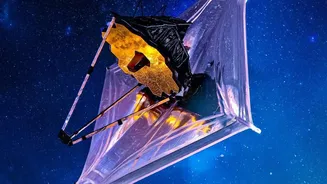
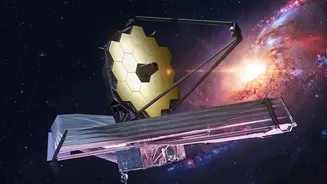
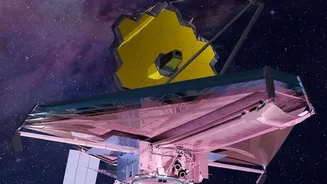
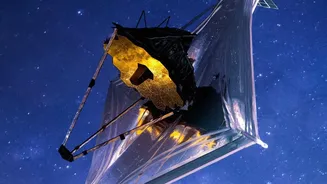
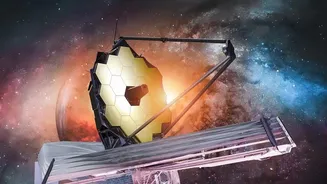
Astronomers using the James Webb Space Telescope discovered what appears to be the oldest and most distant compact pair of quasars ever found. The system, officially named J1602+4228AB, is seen as it was just 900 million years after the Big Bang, during
a period known as the 'cosmic dawn'. The two objects are incredibly close, separated by only about 18,100 light-years, which is roughly one-fifth the diameter of our own Milky Way galaxy. This discovery was made as part of the Aether survey, a JWST program to conduct a census of objects in the early universe. While inspecting the data, researchers noticed a faint companion next to a known quasar, prompting a closer look.
A Primer on Quasars
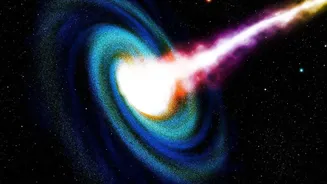
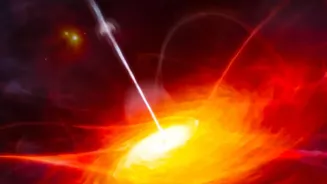
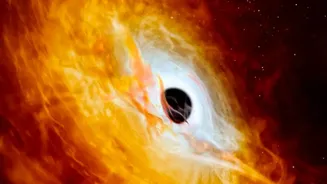
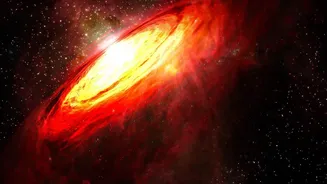
So, what exactly is a quasar? The term is short for 'quasi-stellar object'. Quasars are some of the most luminous objects in the universe, shining with the light of a trillion suns. This intense energy isn't from stars, but from a supermassive black hole at the center of a galaxy that is actively feeding. As gas, dust, and stars are pulled into the black hole, the material heats up immensely, releasing an enormous amount of light and energy that can outshine the entire host galaxy. Because they are so bright, quasars act like cosmic beacons, allowing astronomers to study the conditions of the very early universe.
Why This Discovery Is a Big Deal
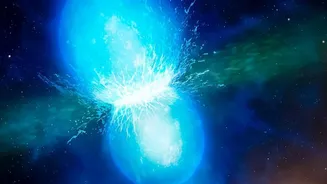
Finding a pair of quasars this early in the universe's history is a major puzzle for astronomers. According to current models of cosmology, it's hard enough to explain how a single supermassive black hole could grow so large, so quickly after the Big Bang. The pair, nicknamed Nāpōwawāʻenakaulua, contains two black holes with estimated masses of 1.5 billion and 400 million times that of our sun. Finding two of them together challenges our understanding of how the universe's first massive galaxies and black holes formed. Scientists believe these pairs are tell-tale signs of galaxy mergers, a key process in cosmic evolution, but finding one so ancient and massive pushes the theoretical limits. It is only the third quasar pair ever found from the era of cosmic dawn.
Enter Gemini North: The Confirmation
This is where teamwork in modern astronomy comes in. While JWST is unparalleled at spotting faint, distant objects, it can be difficult to tell if two close-together points of light are a true pair or a cosmic illusion, like a single object whose light is bent by a gravitational lens. To confirm the discovery, astronomers turned to the Gemini North telescope in Hawai'i. Using its Near-Infrared Spectrograph (GNIRS), the ground-based telescope could perform detailed follow-up observations. Thanks to excellent weather conditions over Maunakea, Gemini North was able to resolve the two objects as individuals and gather separate spectra—a kind of chemical fingerprint of their light. These differences in their spectra strongly suggest they are two distinct quasars.
A New Window into the Early Universe
The successful collaboration between space-based and ground-based telescopes highlights a powerful approach to cosmic discovery. JWST's broad, sensitive eye can identify candidates, while powerful ground observatories like Gemini can perform the detailed analysis needed for confirmation. This particular quasar pair, Nāpōwawāʻenakaulua, provides an unprecedented natural laboratory. It allows scientists to study a region where matter was exceptionally dense, fuelling the rapid growth of both galaxies and their central black holes through mergers. This system offers a concrete example that will help refine simulations and theories about how the first cosmic structures were assembled when the universe was just a fraction of its current age.