






The Battle Against Your Body Clock
Working when it’s dark and trying to sleep when it’s light goes against millions of years of human evolution. Our bodies are governed by an internal 24-hour clock known as the circadian rhythm. This rhythm dictates our sleep-wake cycles, hormone release,
and even body temperature. For most people, this internal clock is synchronised with the sun. However, for those working night shifts, in healthcare, BPOs, or manufacturing, this natural cycle is completely upended. The constant conflict between their work schedule and their body’s natural programming often leads to a condition known as shift work sleep disorder, resulting in chronic fatigue, poor sleep quality, and an increased risk of health problems.
How Light Controls Your Brain
Light is the single most powerful signal that sets our internal clock. When light, particularly blue-toned light, hits photoreceptors in our eyes, it sends a powerful message to a part of the brain called the suprachiasmatic nucleus (SCN). The SCN acts as the body's master clock, and one of its main jobs is to control the production of melatonin, the hormone that makes us feel sleepy. Bright, cool-toned light—the kind that comes from the morning sun, standard LED bulbs, and our phone screens—suppresses melatonin production, telling our brain to be awake and alert. This is helpful during the day, but for a night shift worker trying to sleep in the morning, exposure to this kind of light can be disastrous for restorative rest.
The 'Indoor Sunset' Solution
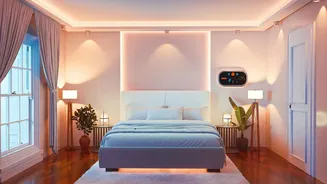
This is where the concept of an 'indoor sunset' comes in. The goal is to mimic the natural transition from day to night, which signals the body to prepare for sleep. In nature, a sunset involves a gradual decrease in light intensity and a shift in colour from bright, blue-white daylight to a warm, deep red and amber glow. Recreating this transition indoors helps gently nudge your body into producing melatonin, even if it’s 8 AM outside. This type of lighting, often called circadian lighting, is designed specifically to support your body’s natural rhythm by changing its colour temperature and brightness throughout the day.
Why Warm Light Works Wonders
The science is clear: not all light is created equal. Studies have consistently shown that light on the red, orange, and amber end of the spectrum has a minimal effect on melatonin suppression. A Harvard study even found that blue light suppressed melatonin for twice as long as green light at similar brightness levels. Light with a high colour temperature (like cool white or daylight bulbs rated at 5000K or higher) is effective at keeping workers alert during a night shift, but it becomes a problem when it’s time to wind down. By switching to light with a low colour temperature (under 3000K, and ideally closer to 2000K) in the hours before you plan to sleep, you can avoid sending your brain the wrong 'wake up' signal.
A Practical Guide for Shift Workers
Implementing an indoor sunset doesn't have to be complicated or expensive. The key is to manage your light exposure strategically. About 90 minutes before your desired sleep time, begin your wind-down routine. Start by dimming your main lights. If you use smart bulbs, this is the perfect time to use them. You can program a 'sunset' routine that gradually shifts the light from white to a warm amber or red colour while slowly fading in brightness. Many smart lighting systems now have a 'Circadian Lighting' feature built-in. If you don’t have smart lights, simply switch to a lamp with a low-wattage, warm-toned bulb. Avoid all screens—phones, tablets, and TVs—as their blue light is particularly disruptive. If you must use a screen, enable its 'night mode' or 'eye comfort shield' to make the display warmer. The goal is to create a cave-like environment of warm, dim light to tell your brain that the day—your day—is ending.
Beyond the Bulb
While lighting is a powerful tool, it’s most effective as part of a broader sleep hygiene strategy. When you finish your shift and head home in the morning, wear sunglasses to block out the bright morning light. Invest in good blackout curtains for your bedroom to ensure it stays dark during your sleep hours. Try to maintain a consistent sleep schedule, even on your days off, to help anchor your body clock. Avoid caffeine for at least six hours before you plan to sleep and try to have your last big meal a few hours before bed. Combining these habits with a carefully controlled light environment can dramatically improve your ability to get the deep, restorative sleep your body needs to recover and thrive despite an unconventional schedule.