





The Known Enemy: Muscle and Bone Loss
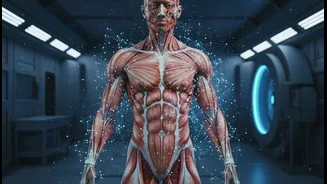
For decades, the most understood threats of long-duration spaceflight were muscle atrophy and bone density loss. On Earth, gravity is a constant force our bodies work against, strengthening our skeletal and muscular systems just by moving around. In microgravity,
this resistance vanishes. Astronauts can lose up to 20% of their muscle mass in under two weeks and bone mineral density at a rate of 1-1.5% per month. To combat this, space agencies implemented strict daily exercise regimens, with astronauts spending about two hours a day on treadmills, stationary bikes, and a special weightlifting machine called the Advanced Resistive Exercise Device (ARED). This has been crucial in maintaining physical conditioning, allowing astronauts to perform demanding tasks and return to Earth in better shape.
A Shift in Focus: Fluids and the Brain
While resistance and aerobic exercise are effective against muscle and bone loss, researchers have found they don't solve every problem. A significant issue is the way bodily fluids behave without gravity. On Earth, gravity pulls fluids down towards our legs. In space, this fluid shifts upwards, leading to a puffy face, congested nose, and, more worryingly, increased pressure in the head. This cephalad fluid shift is now believed to be a primary cause of a condition known as Spaceflight Associated Neuro-ocular Syndrome, or SANS. Astronauts with SANS can experience optic disc swelling, flattening of the eyeball, and vision changes, some of which may not be fully reversible after returning to Earth.
The SANS Challenge
SANS represents a new frontier in space medicine, as up to 70% of astronauts on long missions show some signs of it. The syndrome highlights that simply keeping muscles and bones strong is not enough. Recent studies using MRI scans have shown that microgravity can cause the brain itself to shift upward within the skull. This movement, along with the redistribution of cerebrospinal fluid, puts mechanical stress on the optic nerve and the structure of the eye. Scientists are actively researching why some astronauts are more susceptible than others, looking at factors from genetics to nutrition. Since resistance exercise doesn't directly address this fluid pressure problem, it can't be the sole solution.
The Next Frontier of Countermeasures
With plans for longer missions to the Moon and Mars, where astronauts will be in microgravity for years, finding ways to mitigate SANS and other fluid-related issues is a top priority. Researchers are testing several new countermeasures. One promising method is Lower Body Negative Pressure (LBNP), which involves placing the lower half of an astronaut's body into a sealed chamber and creating a vacuum. This helps pull fluids back down towards the legs, mimicking the effect of gravity for several hours a day. Other ideas being explored include specialized venoconstrictive thigh cuffs, nutritional supplements like Vitamin B, and even devices that gently modulate pressure around the eyes. These solutions, likely used in combination with existing exercise protocols, will be essential for ensuring astronaut health on deep space voyages.