



The Challenge: Signal vs. Noise
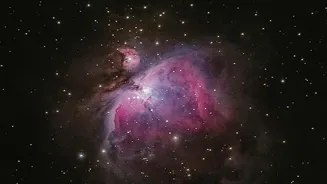
When you look at a photo of a nebula millions of light-years away, you're seeing 'signal' — the actual light from that celestial object. But capturing that faint signal is incredibly difficult. Long exposures in low light cause a camera's sensor to produce
'noise,' which looks like random grain or colourful speckles. This noise can easily overwhelm the faint light from deep-space objects. The core goal of astrophotography is to improve the signal-to-noise ratio (SNR). A high SNR means your image is clean and full of detail; a low SNR means it's a grainy mess. Stacking is the most powerful method photographers have to boost this ratio.
It Starts with Light Frames
An astrophotographer doesn't take just one picture of their target. Instead, they take many—sometimes hundreds—of identical exposures, which are called 'light frames'. Each light frame contains two things: the signal from the galaxy or nebula, and a layer of random noise. Because the signal (the galaxy) is constant in every photo, but the noise is random, software can be used to average them out. Think of it like this: if you average a hundred photos, the consistent light from the stars and nebula adds up and gets stronger, while the random, fizzy noise particles cancel each other out, becoming smoother and less visible. The result is a combined image with far more signal and far less noise than any single shot could provide.
Capturing Nothing to See Everything
To further eliminate noise, photographers shoot several types of 'calibration frames'. These are pictures of, well, nothing. They are essential for telling the software exactly what kind of noise the camera system produces so it can be digitally subtracted. There are three main types. Dark Frames are taken with the lens cap on, using the same exposure time and temperature as the light frames. This captures the thermal noise and hot pixels the sensor generates during a long exposure. Flat Frames are photos of a perfectly uniform, evenly lit surface, like a white t-shirt stretched over the lens. These map out imperfections like dust spots on the sensor and vignetting (darkening at the edges of the lens), ensuring a smooth, evenly illuminated final image. Bias Frames are captured at the camera's fastest shutter speed with the lens cap on. They record the baseline electronic 'read noise' that the sensor produces every time it takes a picture, no matter the exposure length.
The Digital Darkroom: Stacking Software
This is where the magic happens. Specialised software takes all these different frames and puts them to work. Programs like DeepSkyStacker, Siril, or the more advanced PixInsight are popular choices. The process, known as calibration and integration, is largely automated. First, the software subtracts the noise patterns identified in the dark, bias, and flat frames from each individual light frame. This cleans up each shot. Then, it analyses the stars to perfectly align, or 'register,' all the cleaned-up light frames. Finally, it averages them together, combining their signal and drastically reducing any remaining random noise. The resulting file is a single, high-detail, low-noise image ready for final editing.
From Stacked Data to Final Art
The output from a stacking program isn't the final, beautiful image you see online. It's a 'master file' that contains a huge amount of clean data, but often looks dark and lacks contrast. The final step is post-processing, where the photographer uses software like Adobe Photoshop or PixInsight to stretch the data, adjust curves, enhance colour, and sharpen details. This artistic stage is what brings out the faint, swirling arms of a galaxy or the delicate, glowing gases of a nebula. The stacking process provides the clean, high-quality raw material, and post-processing turns that material into a work of art.