


A Sweet Discovery in the Stars
Scientists recently announced a landmark discovery: the first-ever direct detection of a sugar molecule in the interstellar medium, the vast expanse of gas and dust between stars. Using powerful radio telescopes in Spain, an international team of researchers
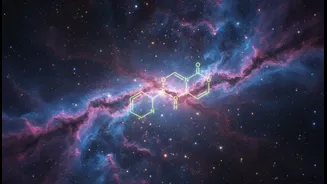
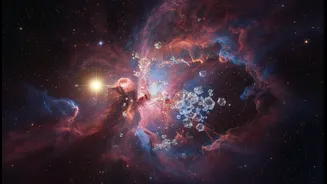
spotted the chemical signature of erythrulose, a four-carbon sugar, in a dense molecular cloud near the center of our Milky Way galaxy. On Earth, this same sugar is naturally found in red raspberries and is even used in some self-tanning products. While sugars have been found in meteorites that have landed on Earth, this is the first time a molecule of this type has been confirmed floating freely in the cosmic nursery where stars and planets are born.
Why This Finding Is So Exciting
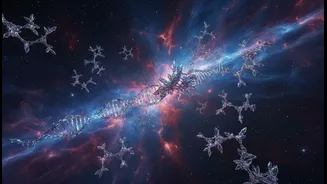
The discovery of erythrulose isn't exciting because astronauts might one day find cosmic raspberries. It’s exciting because sugars are prebiotic molecules—the fundamental building blocks for life as we know it. Sugars form the structural backbone of RNA and DNA, the molecules that carry the genetic code for all living things. The central mystery for scientists studying the origin of life is figuring out how these crucial ingredients came together on early Earth. Finding a complex sugar like erythrulose in a pre-stellar cloud suggests that the basic chemical ingredients for life might not need to form on a planet. Instead, they could be common throughout the galaxy, forming in cold gas clouds long before planets even exist.
A Cosmic Ingredient Delivery Service
This discovery gives strong support to the theory of panspermia, which suggests that the ingredients for life were delivered to Earth from space. Scientists believe that during the early formation of our solar system, a period known as the Late Heavy Bombardment, Earth was constantly pelted by comets and asteroids. If these objects passed through interstellar clouds rich in molecules like erythrulose, they could have acted as a cosmic delivery service, seeding our young planet with the organic compounds needed to kickstart biology. Researchers estimate that millions of tonnes of erythrulose could have rained down on early Earth, enriching the “prebiotic soup” from which life is thought to have emerged.
So, Is It Aliens? Let’s Slow Down
This is where the reality check comes in. Finding erythrulose in space is like finding flour, sugar, and eggs in a kitchen. It tells you that the ingredients for a cake are present, but it doesn't mean a cake has been baked, let alone that a baker is in the house. Erythrulose is just a molecule—a complex and important one, but it is not life. Scientific announcements about “building blocks of life” are often misinterpreted as discoveries of life itself. What scientists have found is evidence of cosmic chemistry, not cosmic biology. It’s a clue about how the journey towards life might begin, both on Earth and potentially elsewhere. But it is the very first step on a very long road.
What Happens Next
The detection of erythrulose is a monumental achievement that opens up a new frontier in astrobiology. It proves that complex prebiotic molecules can and do form in the harsh conditions of deep space. Scientists will now be searching for even more complex sugars, particularly the five-carbon sugar ribose, which is a direct component of RNA. Each new molecule detected adds another piece to the puzzle of our origins. It helps us understand the chemical context of our universe and brings us closer to answering the ultimate question of whether we are alone. This finding isn't proof of alien life, but it’s a powerful reminder that the universe is a vast and creative chemical laboratory.