


Reading the Rainbow of Distant Worlds
Imagine trying to figure out the ingredients of a cake from a hundred kilometres away. This is the challenge astronomers face when studying exoplanets—planets orbiting other stars. The solution is a technique called transmission spectroscopy. When an exoplanet passes
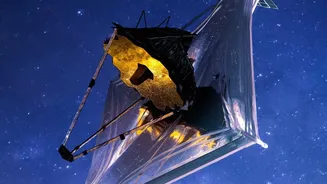
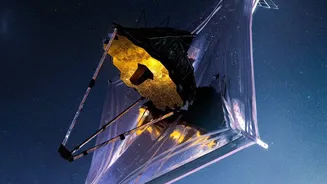
in front of its star from our perspective, a tiny fraction of the starlight filters through the planet’s atmosphere. Molecules in that atmosphere, like water vapour, absorb very specific colours, or wavelengths, of light. This process leaves a unique pattern of missing colours in the starlight, much like a barcode. By capturing this light and splitting it into a spectrum, a rainbow of wavelengths, astronomers can read these "barcodes" to identify the chemical fingerprints of the gases present. This is precisely what the James Webb Space Telescope (JWST) was designed to do with unprecedented power.
Webb’s Infrared Advantage
While the Hubble Space Telescope gave us our first tantalizing glimpses of water on exoplanets, JWST represents a monumental leap forward. Its advantage lies in its enormous mirror and its sensitivity to infrared light. Many key molecules, including water, methane, and carbon dioxide, have strong absorption features in the infrared part of the spectrum, which is invisible to our eyes. JWST can detect these chemical fingerprints with a clarity and precision that was previously impossible. This allows scientists not only to confirm the presence of water but also to measure its abundance, study the planet's temperature, and detect evidence of clouds or haze that might be obscuring the view. These detailed observations provide a much richer, more complete profile of what these distant worlds are actually like.
A Gallery of Water Worlds
Since beginning operations, JWST has delivered stunning results. Early on, it provided a comprehensive molecular and chemical profile of the gas giant WASP-39 b, confirming the presence of water vapour along with a host of other compounds like carbon dioxide and even sulphur dioxide. It gave scientists a full menu of the planet's atmospheric ingredients. More recent observations in 2026 have continued this trend, with reports of water vapour detected in the atmospheres of various planets, including a temperate rocky exoplanet just 48 light-years away. In another fascinating case, Webb even detected heavy water—a variety containing a heavier form of hydrogen—in the atmosphere of WASP-39 b, offering clues about how and where the planet originally formed. However, science is a careful process. For some rocky planets like GJ 486 b, scientists have detected hints of water vapour but are cautiously working to confirm if the signal is truly from the planet's atmosphere or from cool spots on the host star itself.
More Than Just Water
Detecting water is a headline achievement, but spectrum analysis reveals so much more. The presence and ratio of different molecules paint a picture of a planet's chemistry and climate. For instance, on the hot Jupiter WASP-80 b, Webb found both methane and water vapour. Finding both can tell scientists about the balance of carbon and oxygen in the atmosphere, which in turn provides clues about the planet's formation history. On another world, WASP-121b, a June 2026 analysis showed how the atmosphere changes from its hot "morning" side to its cooler "evening" side during its orbit. Water molecules were found to be breaking apart on the hotter side, demonstrating that JWST can even observe active chemistry in real time on these alien worlds. This level of detail moves beyond simple detection and into the realm of true characterization, understanding these planets as dynamic, evolving places.
The Quest for Habitable Worlds
Ultimately, the goal of this atmospheric investigation is to find a planet that could support life. Water is considered a key prerequisite, so finding its vapour is an essential first step. The detection of water on a wider range of planets than previously thought expands the number of worlds that astronomers can consider potentially habitable. The next step is to use Webb's powerful spectrographs to search for biosignatures—combinations of gases, like oxygen and methane together, that are difficult to explain without the presence of life. While we are not there yet, each atmospheric spectrum captured by JWST is a crucial piece of the puzzle. The telescope is not just finding water; it is building a foundational library of alien atmospheres that will guide the search for life beyond Earth for years to come. The ability to move from simply discovering planets to truly understanding their composition marks a new era in astronomy.