

A Glimpse of a 'Steam World'
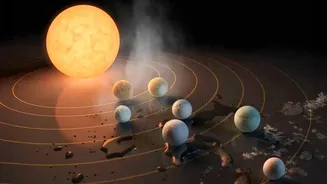
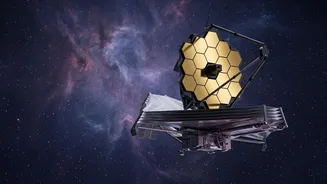
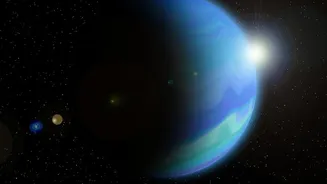
In a landmark discovery, an international team of astronomers used the JWST to confirm the existence of a new, exotic type of planet: a 'steam world'. The planet, known as GJ 9827 d, is located about 100 light-years away. Roughly twice the size of Earth,
its atmosphere is composed almost entirely of hot water vapour. While its scorching temperatures make it inhospitable to life as we know it, the confirmation of a world so drenched in water marks a monumental achievement. For years, scientists theorised that such planets could exist, but GJ 9827 d is the first observational proof, moving the concept from scientific models into reality.
The Science of Starlight
This incredible detection was made possible by a technique called transmission spectroscopy. As an exoplanet passes in front of its host star from our perspective, a tiny fraction of the starlight filters through the planet's atmosphere. The JWST's highly sensitive instruments can capture this light and analyse its spectrum. Different molecules in the atmosphere absorb light at specific wavelengths, leaving behind a unique chemical 'fingerprint'. By reading these dips in the light spectrum, scientists can determine the composition of a world's atmosphere from across the galaxy. The distinct signature of water, H2O, was unmistakable in the data from GJ 9827 d.
From Hints to Certainty
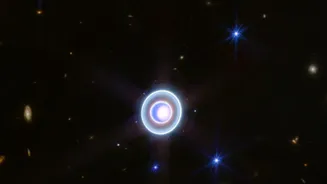
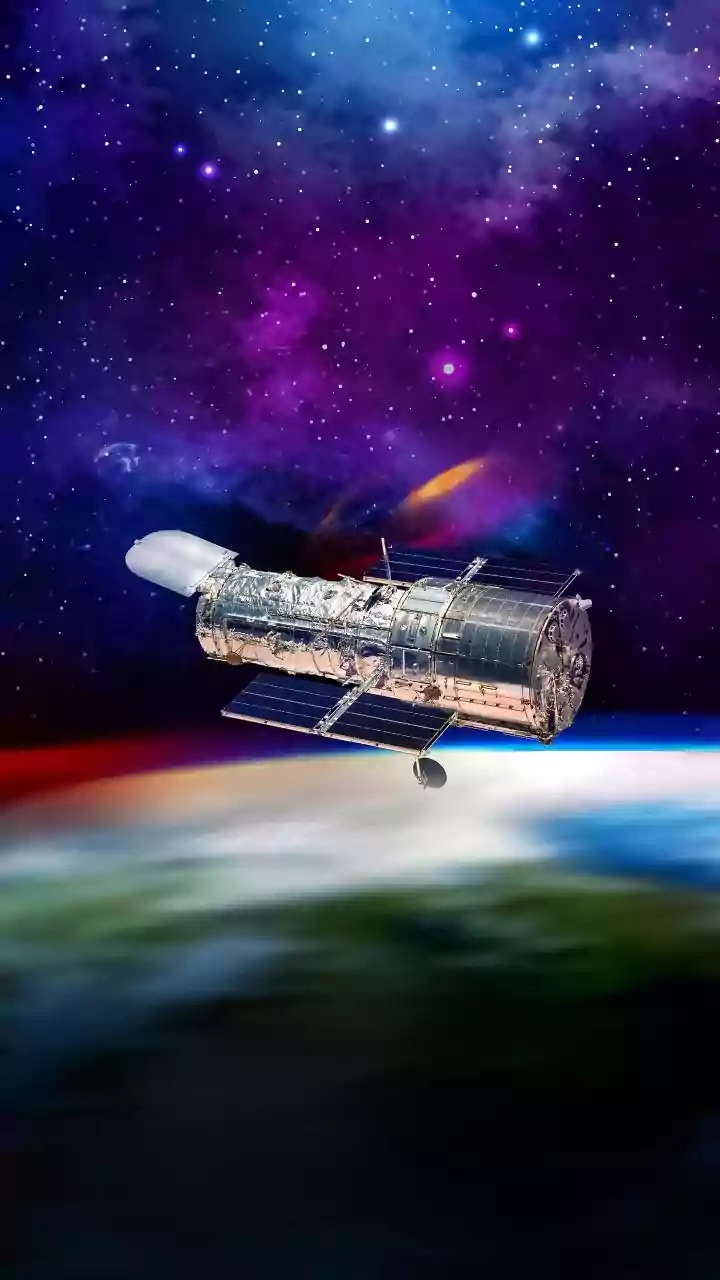
The journey to this discovery highlights the leap in technology that the JWST represents. The planet GJ 9827 d was first spotted by the Kepler space telescope in 2017. Later, observations from the Hubble Space Telescope found intriguing hints of water. However, Hubble's view was not powerful enough to determine the atmosphere's full nature. It took JWST's advanced near-infrared capabilities to turn those tantalising hints into a clear, detailed picture, revealing an atmosphere dominated not by hydrogen and helium like a gas giant, but by heavier molecules like water. This ability to move from suggestion to certainty is what makes the JWST a true game-changer in exoplanet research.
Why Finding Water Matters
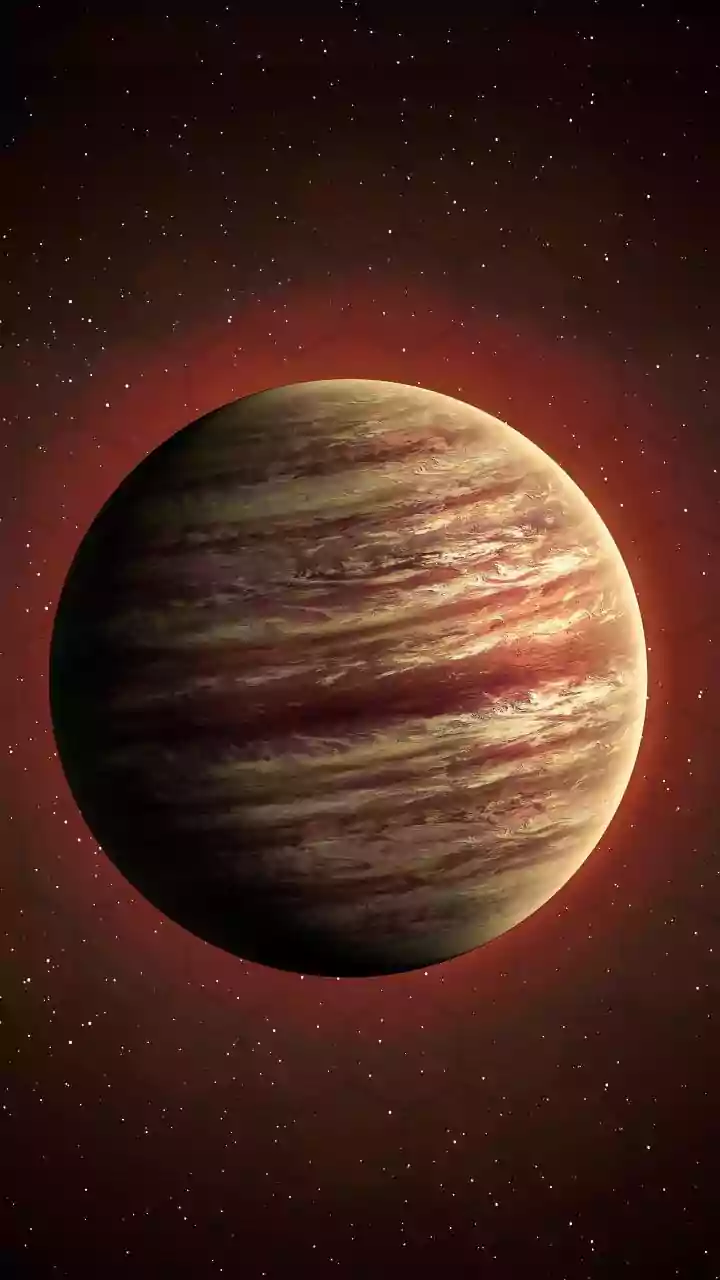
Water is the cornerstone of life on Earth, making its discovery elsewhere a top priority for astrobiologists. While the water on a 'steam world' like GJ 9827 d or the hot gas giant WASP-96 b is in the form of vapour at extreme temperatures, its mere presence is profoundly significant. These findings demonstrate that the building blocks of habitability are common throughout the galaxy. They also serve as a crucial proof of concept, showing that the JWST can successfully detect water-rich atmospheres around smaller planets, not just massive Jupiter-sized worlds. Each detection refines our understanding of how planets form and what kinds of atmospheres they can sustain.
The Search for Another Earth
The discovery of water vapour on distant worlds is not the end goal, but rather a critical step on a much longer journey. Scientists are now using the JWST to probe the atmospheres of rocky planets that orbit within their star's 'habitable zone'—the region where temperatures could allow for liquid water to exist on the surface. The telescope is searching for a full suite of atmospheric gases, including carbon dioxide, methane, and oxygen, which could be potential biosignatures, or indicators of life. While finding a true Earth-twin remains a distant goal, the ability to detect water vapour in the terrestrial-planet-forming zone of other solar systems, as JWST has also done, is bringing us closer than ever before.