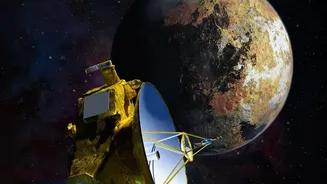







The Old View: A Dead World
Before 2015, our best images of Pluto were fuzzy dots from powerful telescopes. From billions of kilometres away, it was easy to assume the dwarf planet was a simple, inert ball of ice and rock. Scientific models suggested that a body so small and so far
from the sun should have lost any internal heat it once had billions of years ago. Without heat, there could be no geology—no volcanoes, no shifting crust, no activity. Pluto was, for all intents and purposes, considered geologically dead, its surface frozen solid and preserved in time, changed only by the occasional impact from space debris.
New Horizons Rewrites the Story
When NASA's New Horizons spacecraft sent back the first high-resolution images of Pluto, the scientific community was stunned. Instead of a uniformly cratered surface, Pluto displayed a breathtaking variety of landscapes. There were vast, smooth plains of frozen nitrogen, towering mountains of water ice, and deep fissures scarring its crust. The most surprising feature was a giant, heart-shaped glacier named Sputnik Planitia, which showed almost no impact craters. The lack of craters is a key sign of a young surface, meaning something had to have reshaped it relatively recently, geologically speaking. This single observation shattered the old image of Pluto and opened a floodgate of new questions.
The Evidence for Recent Activity
The case for a geologically active Pluto has only grown stronger with further analysis. Scientists have identified several large mountains, including Wright Mons and Piccard Mons, that appear to be massive cryovolcanoes—volcanoes that erupt icy slush instead of molten rock. These structures are enormous, some measuring up to 150 kilometres across and several kilometres high. Their surfaces are also conspicuously free of craters, suggesting they may have been active within the last 100-200 million years, a blink of an eye in geological time. More recent studies have pointed to evidence of liquid nitrogen flowing up from beneath Sputnik Planitia, and even the discovery of massive landslides down crater walls, all pointing towards a world that is far from static.
The Mystery of the Missing Heat
This discovery presents a major puzzle: what is powering this activity? A small world like Pluto shouldn't have enough internal heat left. Several theories are being explored. One idea is that Pluto's core contains a higher-than-expected concentration of radioactive elements, which would generate heat as they decay over billions of years. Another compelling theory is the existence of a vast liquid water ocean buried deep beneath Pluto’s icy shell. This ocean, insulated by the ice crust above and potentially a layer of gas, could retain heat from Pluto's formation and prevent the dwarf planet from freezing completely solid. This internal warmth could be enough to power the cryovolcanoes and keep the nitrogen glaciers slowly churning.
A New Class of World
The revelations about Pluto are forcing scientists to rethink their understanding of icy worlds in the outer solar system. It suggests that even small, distant bodies in the Kuiper Belt can be complex and active. The findings have even reignited the debate about the definition of a planet, with some scientists arguing that a body's geological complexity should be a more important factor than its orbit. Pluto has demonstrated that a world doesn't need to be large or close to a star to have a rich, active geology. It proves that there are powerful processes at play in the coldest reaches of our solar system that we are only just beginning to understand.