


How Webb 'Tastes' the Air of Alien Worlds
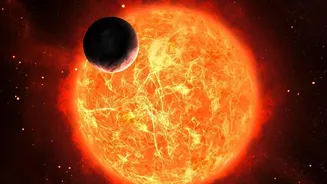
Finding water hundreds of light-years away sounds like science fiction, but it's happening thanks to a clever technique called transmission spectroscopy. When an exoplanet passes in front of its host star from our perspective, a tiny fraction of the starlight
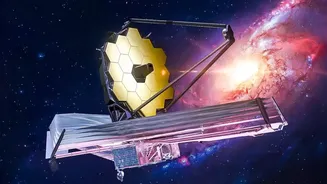
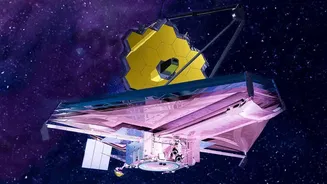
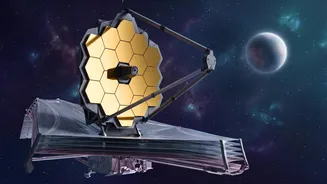
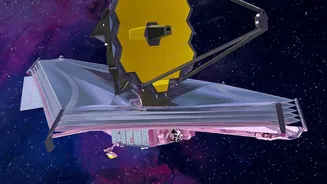
filters through the planet's atmosphere. The James Webb Space Telescope's incredibly sensitive infrared instruments analyse this light. Different molecules in the atmosphere absorb specific colours, or wavelengths, of light. Water, for instance, leaves a very distinct signature, like a chemical fingerprint. By looking at which colours are missing from the starlight after it passes through the atmosphere, scientists can determine which gases are present, including the vital molecule H2O. This method provides an unprecedented look into the chemical makeup of these alien skies, moving us from merely discovering planets to truly characterising them.
Success on Gas Giants
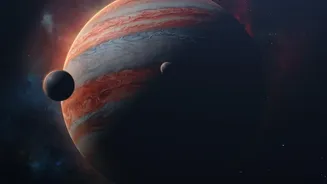
Some of JWST's most detailed atmospheric portraits have come from giant, gaseous planets. Take WASP-39 b, a 'hot Saturn' located about 700 light-years away. Observations from Webb provided a full menu of the atoms and molecules in its atmosphere. Not only did it confirm previous detections of water vapour, but it did so with stunning clarity, even identifying different variations, or isotopologues, of water. The telescope also found a host of other compounds like carbon dioxide, sodium, and potassium. While planets like WASP-39 b are far too hot to be habitable, they serve as crucial test subjects. Proving that the technology works flawlessly on these large, puffy worlds gives scientists the confidence to aim Webb's instruments at smaller, rockier planets that might hold more promise for life.
The Hunt on Rocky, Earth-like Worlds
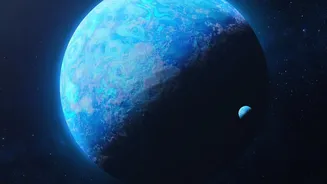
The ultimate prize, of course, is finding water on a rocky planet in its star's habitable zone — the 'Goldilocks' region where temperatures could allow for liquid water on the surface. JWST has already provided tantalising hints in this area. One of the most talked-about examples is K2-18 b, an exoplanet about 120 light-years away. Observations have confirmed a water-rich atmosphere and even detected a molecule called dimethyl sulphide (DMS), which on Earth is overwhelmingly produced by life, primarily phytoplankton. This doesn't confirm the presence of life, as there could be unknown geological or chemical processes at play. However, it's a monumental discovery that turns K2-18 b into a prime target for future study. It represents a huge leap forward in our ability to search for potential biosignatures on worlds that, while not Earth-twins, could still harbour oceans.
The Nuances of Discovery
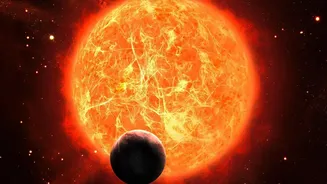
Not every signal is a straightforward discovery. Science is a process of observation, hypothesis, and verification, and sometimes the data is ambiguous. Astronomers studying the rocky exoplanet GJ 486 b, for example, detected a signal that looked like water vapour. This was initially exciting, as finding any atmosphere on a hot rocky planet would be a breakthrough. However, further analysis showed that the signal could be coming from the star itself. Cool spots on the surface of the planet's red dwarf star can contain water vapour, which can mimic the signature of a planetary atmosphere. This doesn't represent a failure, but rather the scientific method in action. It underscores the incredible precision required for these measurements and the caution scientists exercise before announcing a definitive confirmation. It's a reminder that every claim must be rigorously tested.