







The Case of the 'Super-Puff' Planet
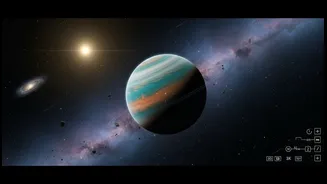
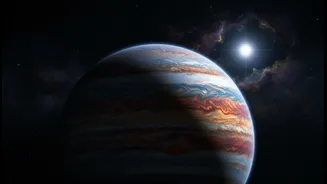
Imagine a planet nearly the size of Jupiter but with only one-tenth of its mass. That’s WASP-107b, an exoplanet located about 200 light-years from Earth that has puzzled scientists since its discovery in 2017. Its incredibly low density makes it one of the lightest
planets ever found, earning it nicknames like “super-puff” and “cotton-candy” planet. For years, astronomers struggled to explain its existence. Standard theories of planet formation suggested that a planet with such a small mass shouldn't have been able to hold onto such a vast, extended atmosphere. It was a celestial mystery that seemed to defy the known rules of how planets evolve.
A Puzzling Lack of Methane
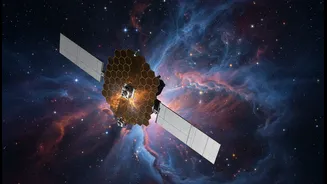
To solve the puzzle, two independent teams of astronomers turned to the most powerful space observatory ever built: the James Webb Space Telescope (JWST). By analyzing the starlight that filtered through the planet's atmosphere—a technique known as transmission spectroscopy—Webb could decipher its chemical makeup. The telescope detected expected molecules like water vapor, carbon dioxide, and sulfur dioxide. But the real clue came from what was missing: methane. The atmosphere contained only one-thousandth of the methane that scientific models predicted for a planet of its temperature. Since methane is unstable at high temperatures, its absence was a critical piece of evidence pointing to something unexpected happening deep inside the planet.
A Hotter Core and Tidal Squeezing
The surprising lack of methane told scientists that the interior of WASP-107b must be significantly hotter than previously thought. This intense internal heat causes vigorous mixing in the atmosphere, churning hot gas from the deep interior up to the cooler upper layers and destroying methane in the process. But what was generating this extra heat? The likely culprit is a process called tidal heating. WASP-107b has a slightly oval, or eccentric, orbit around its star. As it gets closer and farther away during its 5.7-day journey, the star’s gravitational pull constantly stretches and squeezes the planet, generating immense friction and heat deep within its core. This process is similar to how the Moon's gravity creates tides on Earth, but on a much more extreme scale.
Solving the Puffiness Problem
This internal heat is the key to solving the mystery of the planet's puffiness. The new data from Webb allowed researchers to calculate that WASP-107b's core is much more massive—at least twice as massive as previously estimated—and hotter than earlier models suggested. This hotter, more substantial core provides a better explanation for how the planet initially formed by gathering gas. The subsequent tidal heating then provided the energy needed to inflate its atmosphere to its current enormous size, like a marshmallow puffing up in a microwave. Essentially, you can take a Neptune-like planet with a rocky core, turn up its internal temperature, and “poof it up” to look like WASP-107b. The strange planet wasn't formed in some bizarre, unprecedented way after all; it was just much hotter on the inside.
Why This Discovery Matters
Figuring out the secrets of one strange planet might seem like a niche discovery, but it has broad implications for astronomy. This breakthrough helps solve a long-standing mystery in exoplanet science, potentially explaining the existence of dozens of other low-density, puffy planets found across the galaxy. More importantly, it demonstrates the incredible power of the James Webb Space Telescope. We are moving beyond just finding distant worlds to truly understanding them—characterizing their weather, their chemistry, and the complex physics that shape their evolution. Each discovery, from sand clouds to surprising temperatures, provides a new piece of the puzzle in the ultimate search for habitable worlds and our place in the universe.