



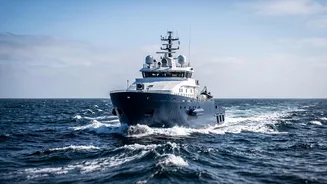
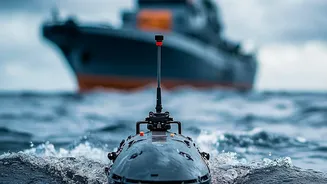
The idea of giant cargo ships navigating the oceans without a human crew is moving from science fiction to reality. Now, researchers at IIT Madras have developed a crucial tool called SeaNav to make this future safer and more accessible than ever.
What is SeaNav?
SeaNav
is a cutting-edge 'digital twin' platform developed by the Department of Ocean Engineering at IIT Madras. Think of it as an incredibly realistic video game for self-driving ships. Instead of testing expensive and potentially hazardous autonomous navigation systems in the real world, SeaNav provides a high-fidelity virtual maritime environment. This digital world allows developers to simulate everything from ships and sensors to unpredictable ocean conditions and busy vessel traffic, all in real time. The goal is to provide a safe, cost-effective, and scalable platform to test, validate, and train the artificial intelligence that will one day guide these vessels. By creating a virtual proving ground, IIT Madras is tackling one of the biggest hurdles in the global race towards autonomous shipping.
A Virtual World Built on Real Physics
The power of SeaNav lies in its remarkable accuracy. Built using the Unity3D game engine, the platform creates a digital replica of the maritime world that isn't just for show. It accurately simulates complex factors like ocean waves and the specific movements of different vessels. To ensure the results are reliable, the simulator has been carefully calibrated using a benchmark model of a 320-meter-long commercial tanker. This means that when an AI system successfully navigates a challenge within SeaNav, there is a high degree of confidence it can perform similarly in the real world. This combination of digital twin technology, AI, advanced sensor fusion, and virtual reality creates a robust environment where both autonomous systems and human operators can be trained safely and efficiently before being deployed at sea.
Why Controlled Trials Are Critical
Autonomous ships navigate using a complex array of sensors like lidar, radar, GPS, and cameras, all feeding data into an AI brain. This AI must interpret the data to avoid collisions, follow international maritime rules, and navigate safely in all weather conditions. However, the ocean is an unpredictable environment. The consequences of a software glitch or a sensor failure are far more severe than in a self-driving car. Real-world testing is not only incredibly expensive but also carries significant risks to other vessels and the marine ecosystem. SeaNav allows researchers to push navigation algorithms to their limits by creating worst-case scenarios—like sudden storms or complex traffic situations—without any real-world danger. This ability to repeat, analyse, and refine performance in a controlled setting is essential for building the trust and reliability needed for widespread adoption.
Anchoring India's Maritime Future
The development of SeaNav is a significant step for India's ambitions in the global maritime sector. The project aligns perfectly with national initiatives like the 'Sagarmala Programme' and 'Maritime India Vision 2030', which emphasize the need for smart ports, digital technologies, and autonomous systems. By developing this foundational technology, IIT Madras is helping to position India as a key player in the rapidly growing market for autonomous maritime solutions. The platform has the potential to directly enhance safety and efficiency at major Indian ports like Chennai, Mumbai, Visakhapatnam, and Kochi by helping develop AI-assisted navigation systems tailored to their unique traffic and environmental conditions. Beyond commercial shipping, the technology's multi-vessel simulation capabilities could be applied to coastal surveillance, search-and rescue operations, and maritime defence.