A New Focus: The Ocean World
The search for extraterrestrial life has long been guided by a simple principle: follow the water. While Mars shows evidence of ancient rivers and lakes, its water is now largely gone. In contrast, Europa and Enceladus offer something far more tantalizing:
vast, stable oceans of liquid water that exist today. These are not small, isolated pockets but global oceans concealed beneath protective shells of ice. Scientists estimate Europa may hold more than twice the amount of liquid water found in all of Earth's oceans combined. This discovery has fundamentally altered our understanding of where habitable environments might exist, shifting the focus from sun-scorched rocky surfaces to the dark, deep interiors of frozen moons.
The Key Ingredients for Life
As we understand it, life requires three fundamental ingredients: liquid water, essential chemical elements, and a source of energy. Both Europa and Enceladus appear to have all three. The presence of liquid water is the most critical. Beyond that, life needs chemical building blocks, often abbreviated as CHNOPS (carbon, hydrogen, nitrogen, oxygen, phosphorus, and sulfur). Observations of Enceladus's plumes have confirmed the presence of water vapor, methane, carbon dioxide, ammonia, and complex organic molecules. Europa's surface shows evidence of salts and sulfur compounds, suggesting its ocean is also chemically rich. The final ingredient is energy. Far from the Sun, life can't rely on photosynthesis. Instead, it would need chemical energy, likely produced by hydrothermal vents on the ocean floor, similar to those found in Earth's deepest oceans. Evidence of molecular hydrogen in Enceladus's plumes strongly suggests these vents are active.
Europa: Jupiter's Watery Giant
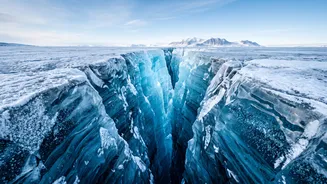
Europa, a moon roughly the size of our own, is a top contender. Its icy crust, though miles thick, shows numerous cracks and reddish streaks, hinting at a dynamic relationship with the ocean below. The key evidence for its ocean comes from data gathered by the Galileo spacecraft. It detected a disruption in Jupiter's magnetic field around Europa, which strongly implies the presence of a global, electrically conductive layer—a salty ocean. Furthermore, the gravitational pull from Jupiter creates tidal forces that flex and heat Europa's interior, keeping its ocean from freezing solid. Water plumes may even erupt through the ice, offering a potential way to sample the ocean without drilling. This combination of a long-lived ocean, a potential seafloor for chemical reactions, and protection from surface radiation makes Europa incredibly compelling.
Enceladus: The Geyser Moon
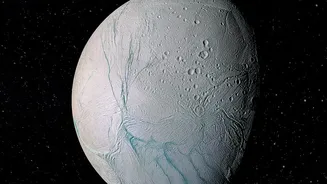
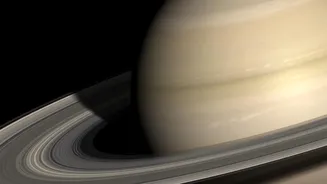
Saturn's moon Enceladus is much smaller than Europa but no less exciting. What makes it unique are the massive plumes of water vapor and ice particles that continuously erupt from 'tiger stripe' fractures near its south pole. NASA's Cassini spacecraft flew directly through these plumes, sampling their contents. It found not just water and salts, but also silica nanoparticles, molecular hydrogen, and carbon-based organic compounds. This is a smoking gun for active hydrothermal vents on the seafloor, where superheated, mineral-rich water from the moon's rocky core mixes with the ocean. This process creates a chemical disequilibrium that could provide energy for microbes, a process known as methanogenesis on Earth. Enceladus is essentially sending free samples of its ocean out into space, making it a prime target for a future mission.
The Next Frontier: Future Missions
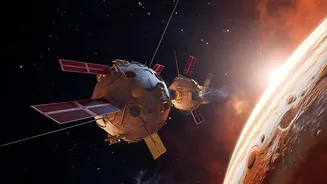
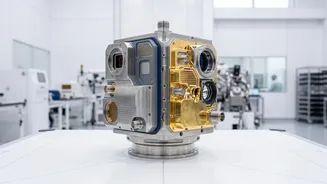
This scientific excitement is fueling a new era of exploration. NASA's Europa Clipper mission, launched in October 2024, is currently en route to Jupiter. It will perform dozens of close flybys of Europa, using ice-penetrating radar and a magnetometer to confirm the ocean's existence, measure its depth and salinity, and scout for potential landing sites. While Clipper is not a life-detection mission itself, it will characterize Europa's habitability. Looking further ahead, the European Space Agency (ESA) is planning a major mission to an icy moon for the 2040s, with Enceladus being a top candidate. The concept includes an orbiter and a lander, which could directly sample surface materials near a plume source, bringing us closer than ever to answering whether we are alone in the solar system.