



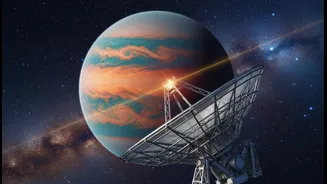




A Whiff of a Distant Ocean
Located 124 light-years away, K2-18b is a 'sub-Neptune' planet that has captured the imagination of scientists and the public. Initial observations by the James Webb Space Telescope (JWST) suggested it could be a 'Hycean' world—a planet with a global
liquid water ocean under a hydrogen-rich atmosphere. The excitement peaked when a research team reported detecting traces of dimethyl sulfide (DMS) in its atmosphere. On Earth, DMS is overwhelmingly produced by life, particularly marine phytoplankton, making its potential presence on another world a groundbreaking biosignature. This discovery, if confirmed, would represent one of the most significant hints of biological activity beyond our solar system. The finding propelled K2-18b from an object of interest to a prime target in the quest to answer one of humanity's biggest questions.
The Data Under Debate
However, science is a process of verification, and extraordinary claims require extraordinary evidence. Almost as soon as the potential DMS detection was announced, other research groups began to scrutinize the data. Several independent analyses of the same JWST observations have since been published, casting doubt on the initial finding. These subsequent studies argue that the signal attributed to DMS is not statistically significant. The issue, they suggest, lies in 'data errors' or 'noise.' This can stem from the extreme sensitivity of the telescope's instruments being pushed to their absolute limits, or from a phenomenon known as stellar contamination. Essentially, the faint signal from the planet’s atmosphere is incredibly difficult to separate from all the other light and radiation, leading to conflicting interpretations of what the data truly shows.
The Problem with an Active Star
A major source of these data errors is K2-18b's parent star. The planet orbits a red dwarf, a type of star known for being magnetically active, with frequent starspots and powerful flares. When scientists study K2-18b's atmosphere, they do so by analyzing starlight that passes through it—a technique called transmission spectroscopy. The problem is that active regions on the star's surface can create chemical signatures that mimic or mask the very signals scientists are looking for in the planet's atmosphere. This 'stellar contamination' can lead to a false positive, making it appear as if a molecule like DMS is present when it's actually an artifact caused by the star itself. Disentangling the planet's true atmospheric composition from the noise of its star is one of the greatest challenges in exoplanet science today.
A Different Hunt: The Radio Survey
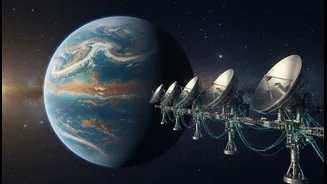
Adding another layer to the investigation, a separate and massive radio survey of K2-18b was recently conducted. As reported on July 14, 2026, astronomers used two of the world's most powerful radio telescope arrays, the Very Large Array (VLA) in the US and MeerKAT in South Africa, to listen for signals from the system. However, this project had a different goal. It was a Search for Extraterrestrial Intelligence (SETI) campaign, looking not for chemical biosignatures but for technological ones—artificial radio transmissions that could indicate a communicative civilization. The powerful survey analyzed millions of potential signals, employing sophisticated software to filter out Earth-based interference. While it ultimately found no convincing evidence of alien technology, the project pioneered new data-filtering techniques that will make future SETI searches far more efficient.
Two Searches, One Target
At first glance, the atmospheric study and the SETI radio survey seem entirely disconnected. One is 'sniffing' for signs of basic biology, while the other is 'listening' for advanced technology. The radio survey was not designed to correct the JWST's data errors. However, together they paint a fuller picture of how scientists are tackling the search for life. While the JWST looks for clues in infrared light, radio telescopes offer a window into other phenomena. In principle, radio observations can be used to monitor the very stellar activity that contaminates atmospheric data, helping to 'scrub' the planetary signals clean. Though this specific survey was for SETI, it demonstrates the multi-faceted approach required. Investigating a world like K2-18b isn't a single discovery; it's a campaign fought on multiple fronts with different technologies, each providing a unique piece of the puzzle.