



What is a 'Deep Field'?
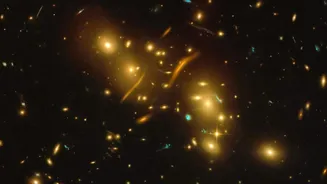
Imagine pointing a camera at what seems to be an empty, dark patch of sky and leaving the shutter open for hours or even days. That's the essence of a 'deep field' observation. Instead of an empty void, the long exposure reveals a tapestry of thousands
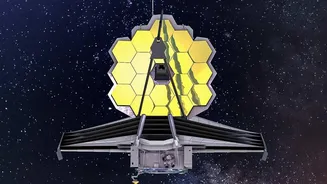
of distant galaxies. The Hubble Space Telescope pioneered this technique, but JWST, with its advanced infrared sensitivity, has taken it to an entirely new level. Its first deep field image, focusing on a tiny sliver of the sky the size of a grain of sand held at arm's length, revealed thousands of galaxies, some seen as they were when the universe was less than a billion years old. This ability to peer through cosmic dust and capture the stretched-out, ancient light allows astronomers to see farther back in time than ever before, into an era known as the 'Cosmic Dawn'.
Seeing the Universe's First Light
One of JWST's primary missions is to study the Cosmic Dawn, the period a few hundred million years after the Big Bang when the first stars and galaxies formed. Before this, the universe was filled with a thick fog of neutral hydrogen gas that made it opaque. The first brilliant, hot stars and galaxies emitted intense radiation that began to burn away this fog, a process called reionization. By spotting galaxies from this era, like JADES-GS-z14-0 which dates back to just 300 million years after the Big Bang, JWST is providing the first direct evidence of how this process unfolded. Astronomers are finding that small, faint galaxies likely played a huge role in clearing this cosmic fog, turning on the lights in the universe for the first time.
A Surprising Cosmic Youth
One of the biggest surprises from Webb's deep field views is how advanced the earliest galaxies appear. According to many cosmological models, the first galaxies should have been small, clumpy, and chaotic. Instead, JWST is finding galaxies in the early universe that are surprisingly massive, structured, and contain more complex elements than predicted. Some even host supermassive black holes far earlier than theories suggested was possible. This doesn't necessarily mean the Big Bang theory is wrong, but it strongly suggests that the process of galaxy and black hole formation was much faster and more efficient than previously understood. These findings are forcing scientists to refine their models of how cosmic structures grow.
Mapping the Cosmic Web
Galaxies aren't scattered randomly throughout space; they are arranged in a vast, interconnected structure known as the cosmic web. This 'skeleton' of the universe consists of long filaments of dark matter and gas, with galaxies forming along these threads like beads on a string. Using the largest survey conducted to date, called COSMOS-Web, astronomers have leveraged JWST's power to map this structure with unprecedented detail, tracing it back to when the universe was only a billion years old. By seeing not just the individual galaxies but their place within this larger architecture, scientists can better understand how a galaxy's environment—whether it's in a dense cluster or a lonely void—influences its growth and evolution over billions of years.
Solving the Mystery of 'Little Red Dots'
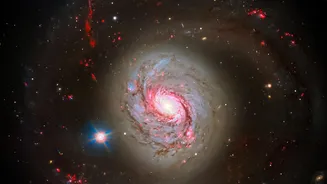
Scattered across Webb's deep field images are enigmatic objects nicknamed 'little red dots'. These are extremely compact and bright in infrared light, appearing in huge numbers in the very early universe before seemingly vanishing. For a time, astronomers were puzzled, wondering if they were a new type of celestial object. Recent observations suggest these may be the incredibly bright, dust-shrouded cores of early, actively growing galaxies, potentially powered by rapidly growing black holes. As these galaxies evolved over cosmic time, they developed spiral arms and other features, changing their appearance. The 'little red dots' didn't disappear; they simply grew up, and JWST is allowing us to connect these infant stages to the mature galaxies we see in the later universe.