



A New Light in the Heavens
In early October 1604, observers in Europe and Asia noticed a dazzling point of light in the constellation Ophiuchus, the serpent-bearer. It hadn't been there before. This 'new star' quickly grew in intensity, eventually outshining the planet Jupiter
and becoming so bright it was visible during the day for over three weeks. For a world that largely believed the heavens beyond the Moon were perfect and unchanging, this sudden appearance was a profound mystery. It was witnessed across the globe, with records from Italy, China, and Korea. The event occurred during a planetary conjunction of Mars and Jupiter, a focus for astronomers at the time, ensuring many eyes were already pointed toward that patch of sky.
Enter Johannes Kepler
Working as the Imperial Mathematician in Prague, Johannes Kepler was one of the leading scientific minds of his era. Though he wasn't the first to see the new star—cloudy weather prevented him from observing it until October 17—he quickly began a systematic and meticulous study. Inspired by Tycho Brahe's work on another supernova in 1572, Kepler tracked the star's position and brightness for over a year until it faded from naked-eye view in 1606. While many others observed the star, it is Kepler's comprehensive work, 'De Stella Nova in Pede Serpentarii' ('On the New Star in the Foot of the Serpent-Bearer'), that made him the phenomenon's primary chronicler. It is for this reason the event now bears his name: Kepler's Supernova.
Shattering a Perfect Cosmos
The appearance of SN 1604 was more than just a celestial curiosity; it was a direct challenge to the long-held Aristotelian view that the realm of stars was eternal and immutable. Kepler, like Galileo Galilei who also observed the event, used careful measurements to determine that the star showed no parallax—the apparent shift in position of an object when viewed from different locations. This lack of parallax proved it was not a comet or an atmospheric phenomenon, but was located far away, in the sphere of the 'fixed stars'. This, along with the 1572 supernova, provided powerful evidence that the heavens were indeed a place of change and dynamic activity, a key idea that fueled the ongoing Scientific Revolution.
What We Know Today: A Star's Violent Death
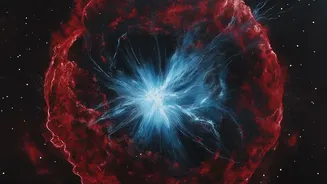
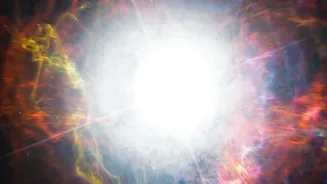
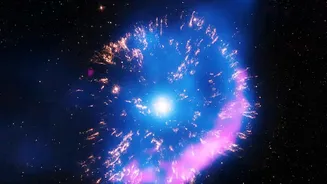
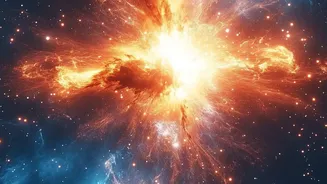
What Kepler and his contemporaries thought was the birth of a star was, in fact, its violent death. Modern astronomers have identified Kepler's Supernova, or SN 1604, as a Type Ia supernova. This type of explosion happens in a binary star system where a small, dense star called a white dwarf pulls matter from its larger companion star. When the white dwarf accumulates too much mass, it triggers a runaway thermonuclear explosion, blasting its material into space and creating the brilliant burst of light seen in 1604. The remnant of this explosion, a beautiful and expanding cloud of gas and dust, can still be studied today with powerful X-ray and radio telescopes, located about 20,000 light-years from Earth.
The Legacy of Kepler's Star
SN 1604 holds a unique place in history: it is the most recent supernova to have been definitively observed with the naked eye within our own Milky Way galaxy. While other, more recent supernovas have occurred in our galaxy, they were obscured by interstellar dust and not visible to casual observers on Earth. And while a supernova was seen in a nearby satellite galaxy in 1987, more than 400 years have passed since a star's explosion in our own cosmic neighbourhood was so spectacularly visible. Kepler's star remains a powerful link to a pivotal moment when humanity's view of the universe was fundamentally changing, from one of static perfection to one of dynamic and violent beauty.