



Our First Responder in Space
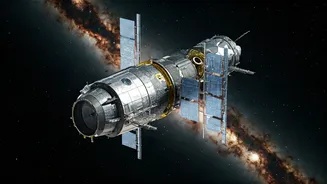
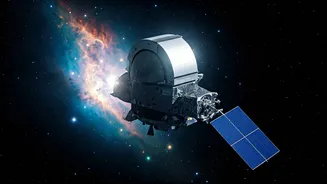
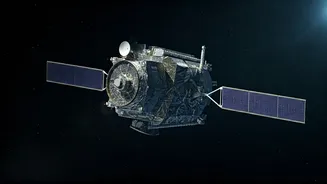
Launched in 2004, the Neil Gehrels Swift Observatory is a space telescope with a unique and urgent mission: to hunt for gamma-ray bursts (GRBs). These are the most powerful explosions in the universe, marking cataclysmic events like the birth of black
holes or the collision of dense neutron stars. Swift's key feature is its speed. Its Burst Alert Telescope (BAT) scans a huge portion of the sky, and upon detecting a GRB, the entire spacecraft can pivot in under two minutes to focus its X-ray and ultraviolet/optical telescopes on the fading afterglow. This rapid response has made it NASA's 'first responder' for transient cosmic events, providing crucial data that no other observatory can capture so quickly. This ability to catch fleeting phenomena has been fundamental to our understanding of the high-energy universe.
A Crisis of Falling Altitude
Unlike a component failure, the threat to Swift came from our own Sun. In recent years, heightened solar activity has caused Earth's upper atmosphere to expand or "puff up." For a satellite in low Earth orbit like Swift, this expanded atmosphere creates increased aerodynamic drag. Without its own propulsion system to counteract this pull, Swift began to lose altitude at an alarming rate, falling from its original 600-kilometer orbit to below 400 kilometers. Projections showed that if nothing was done, the celebrated observatory would re-enter the atmosphere and burn up, potentially as early as late 2026. Faced with losing a unique scientific asset that would cost hundreds of millions of dollars and years to replace, NASA opted for a bold alternative.
An Unprecedented Robotic Rescue
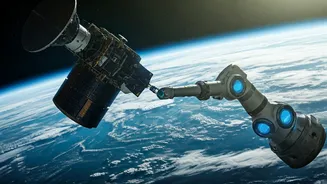
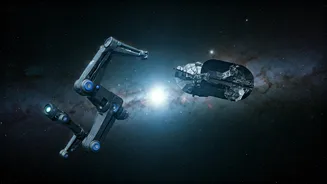
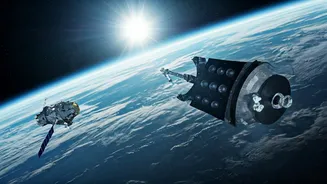
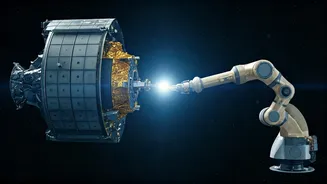
The solution is a first-of-its-kind mission for the U.S.: sending a robotic tugboat to give Swift an orbital boost. NASA awarded a contract to Katalyst Space, a commercial company, to design, build, and operate a servicing spacecraft called LINK. The mission is exceptionally challenging because Swift was never designed to be serviced, grabbed, or docked with in orbit. The refrigerator-sized LINK spacecraft is equipped with three robotic arms designed to carefully grapple the observatory without damaging its 20-year-old hardware. After several delays due to weather and a launch vehicle issue, the mission to get LINK into orbit is pending, with teams reviewing data before setting a new launch date. Once in space and after several weeks of checks, LINK will spend about a month cautiously approaching Swift before attempting to capture it.
A New Lease on Cosmic Life
If the capture is successful, LINK will use its gentle, high-efficiency ion thrusters to slowly push the observatory back up to a higher, more stable orbit over several months. The goal is to return Swift to an altitude near its original 600 kilometers, a process that would restore its operational safety margin. This boost would not only save the observatory from imminent destruction but could also significantly extend its mission. By successfully raising its orbit, the rescue could add another decade of scientific discovery to Swift's already impressive legacy. This would allow astronomers to continue relying on its rapid alerts for studying everything from supernovae to the cosmic counterparts of gravitational waves. The mission represents a high-risk, high-reward effort to preserve a critical piece of scientific infrastructure.