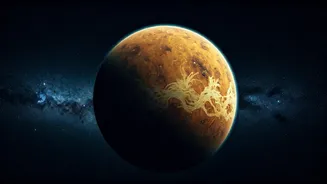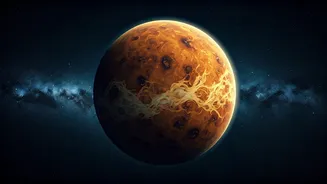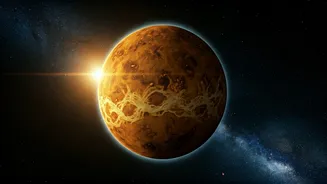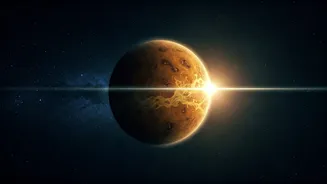






The Core Paradox: A Day Longer Than a Year
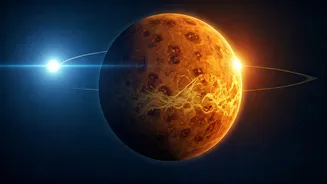
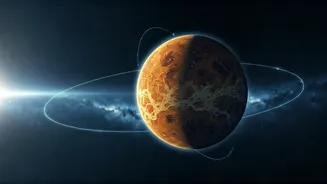
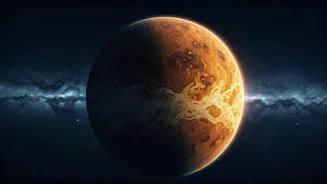
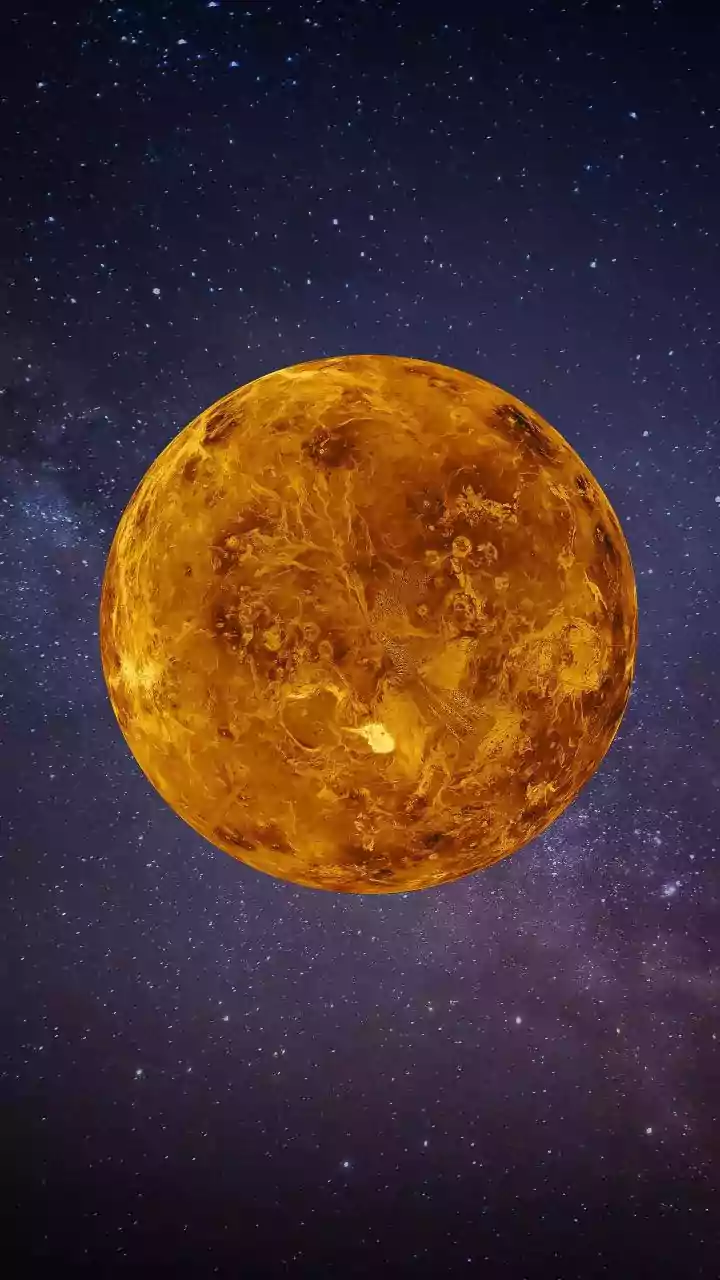
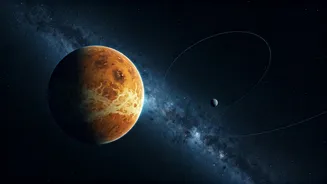
Let’s get the mind-bending fact out of the way first. It takes Venus about 225 Earth days to complete one orbit around the Sun. This is its year. However, it takes the planet a staggering 243 Earth days to complete just one rotation on its axis. This is its sidereal
day. So, yes, a single day on Venus is about 18 Earth days longer than its entire year. This isn't a trick or a riddle; it's a fundamental and bizarre characteristic of our planetary neighbour. While Earth’s day and year are neatly synchronised to give us our seasons and daily rhythm, Venus operates on a completely different and far more sluggish timetable. This simple but profound difference is what makes the planet a source of endless fascination for astronomers and a viral topic for the rest of us.
It Spins the Wrong Way
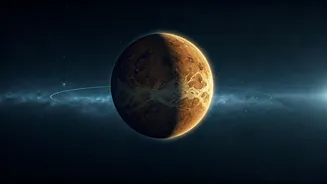
Adding to the strangeness is Venus’s rotation. Nearly every planet in our solar system, including Earth, spins counter-clockwise on its axis. This is known as prograde rotation. If you were looking down from above the solar system's north pole, you'd see them all spinning like tops in the same general direction. But not Venus. It spins clockwise, a motion known as retrograde rotation. The only other major planet that does this is Uranus, which is tilted so far on its side it’s practically rolling. On Venus, this backward spin means the Sun rises in the west and sets in the east. This unique rotation is a key piece of the puzzle in understanding its weirdly long day.
Sunrise to Sunrise: The Solar Day
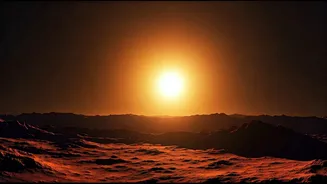
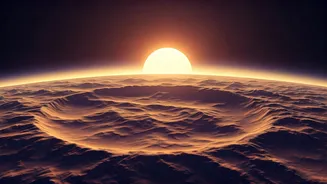
Here's where it gets even weirder. We've established a Venusian year is 225 Earth days, and its rotational period (a sidereal day) is 243 Earth days. But what about a 'solar day'—the time from one sunrise to the next? Because Venus spins so slowly and in the opposite direction of its orbit, these two motions work against each other in a strange way. The result is that a solar day on Venus is significantly shorter than its rotational period. From one sunrise to the next, it takes about 117 Earth days. So, if you could stand on Venus's scorching surface, you would experience a 'day-night' cycle that lasts 117 Earth days, during which the planet would have completed nearly half of its year-long journey around the Sun. You'd see two sunrises for every one trip around the sun.
Why So Slow? The Atmospheric Brake
So, why does Venus spin so slowly and backward? The leading theory points to its oppressively thick atmosphere. Venus's atmosphere is about 90 times denser than Earth's, composed almost entirely of carbon dioxide. This heavy blanket of gas creates immense pressure and powerful thermal tides. As the Sun heats the atmosphere, it creates atmospheric waves that exert a gravitational pull on the planet itself. Over billions of years, this constant, massive atmospheric drag may have acted as a powerful brake, slowing Venus’s rotation from what was likely a much faster, more 'normal' spin in its early history. The friction between the solid planet and its super-rotating atmosphere is so intense that it has fundamentally reshaped the planet's sense of time.
An Ancient, Violent Past
Another theory, which may work in concert with the atmospheric braking model, points to a violent history. Some scientists speculate that early in its formation, Venus was struck by a massive asteroid or protoplanet. Such a cataclysmic impact could have been powerful enough to not just slow its rotation but completely reverse it, sending it into the retrograde spin we see today. It's also possible that a series of smaller impacts over time contributed to this effect. While evidence of such an ancient collision is difficult to find, it remains a plausible explanation for Venus's initial flip. Today, most scientists believe that both an initial catastrophic event and the subsequent, long-term atmospheric braking are responsible for the bizarre Venusian clock.