






Understanding Runner’s Knee Pain
Patellar tendinopathy, often called "runner's knee" or "jumper's knee," is an overuse injury affecting the patellar tendon. This crucial tendon connects your kneecap (patella) to your shinbone and works with your quadriceps muscles to extend your knee every
time you run. The pain is typically a sharp, localized ache directly below the kneecap that worsens with activities like running (especially downhill), squatting, or descending stairs. It happens when the cumulative stress on the tendon from repetitive impact exceeds its ability to repair and adapt. This isn't just simple inflammation; it's a structural issue where the organized collagen fibers in the tendon can become disorganized and weaker, making it less capable of handling load. Rapid increases in mileage or intensity are common culprits, as tendons adapt much more slowly than your cardiovascular system.
Why Tendons Need a Different Approach
Muscles and tendons are different. While muscles get stronger through a general process of breakdown and repair, tendons require a specific type of stimulus to thrive. Tendons are made of dense, parallel collagen fibers, and their strength depends on this highly organized structure. The most effective way to encourage this structure is through a process called mechanotransduction. This is where mechanical force is converted into biochemical signals that tell tendon cells (tenocytes) to produce new, healthy Type I collagen—the strongest kind. This is precisely what slow, heavy loading achieves. It provides the right signal for the tendon to remodel itself, laying down stronger, more aligned fibers that can better withstand the demands of running.
The Power of Slowing Down: Eccentric Training
Every movement has two main phases: a concentric phase (when the muscle shortens, like standing up from a squat) and an eccentric phase (when the muscle lengthens under load, like lowering into a squat). Eccentric training specifically emphasizes this lengthening or lowering phase. Research has shown that slow eccentric contractions are uniquely effective for tendon health. This controlled lengthening places high tension on the tendon, which is the key stimulus needed for collagen remodeling, without the explosive stress that might aggravate it. For runners, this means building a tendon that can better absorb the braking and impact forces that occur with every single footstrike, especially during downhill running.
Key Exercise 1: Single-Leg Decline Squat
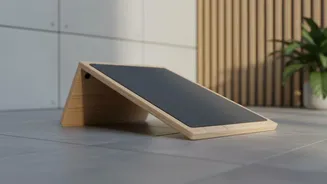
The single-leg decline squat is a classic and highly effective exercise for targeting the patellar tendon. Using a slant board or a wedge (a 25-degree angle is often recommended) increases the load specifically on the patellar tendon.
How to do it:
1. Stand on the slant board with only the leg you want to train. Your other foot can be held off the ground behind you for balance.
2. Keeping your torso upright, slowly lower yourself into a squat. The key is the tempo: take a full three to five seconds to complete the downward movement.
3. Lower until your knee is bent to about 60-90 degrees, or as far as you can without significant pain. A little discomfort is often expected, but it shouldn't be sharp or worsening.
4. At the bottom, place your other foot down and use both legs to push yourself back to the starting position. This ensures the focus remains on the eccentric phase for the target leg.
Key Exercise 2: The Spanish Squat
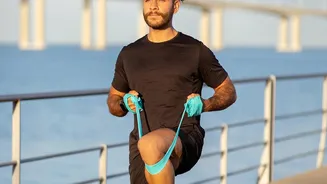
The Spanish Squat is another excellent exercise that allows you to load the quadriceps and patellar tendon with less direct pressure on the knee joint itself. It uses a heavy resistance band to act as a counterbalance.
How to do it:
1. Anchor a heavy, non-elastic strap or resistance band to a sturdy pole or squat rack at knee height.
2. Step into the loop with both feet and position the band behind both of your knees.
3. Walk backward until there is significant tension on the band. Your feet should be about shoulder-width apart.
4. Lean your weight back into the band and squat down, keeping your torso upright and your shins almost perfectly vertical. The band's tension helps you maintain this form.
5. You can perform these as slow, controlled reps (3-5 seconds on the way down) or as isometric holds, holding the bottom position for 30-45 seconds.
How to Integrate These Into Your Routine
Consistency is more important than intensity. Start by incorporating these exercises into your strength training days, ideally twice a week. A common protocol for decline squats is 3 sets of 15 repetitions, performed twice daily, but it's crucial to start where you are and progress slowly. For the Spanish Squat, 3 sets of 8-15 reps or 3 sets of 30-45 second holds is a good target. It's best to perform these exercises on non-running days or after a run, not before, as they can cause some initial fatigue. As the exercises become easier and pain-free, you can add weight (holding a dumbbell or kettlebell) to continue challenging the tendon and building strength.