

The Bread of Sailors and Farmers
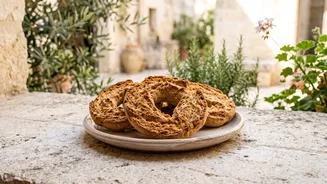
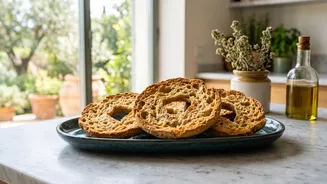
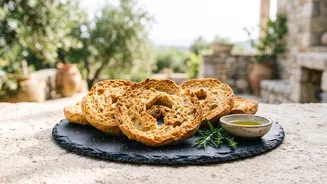
Friselle (pronounced free-zeh-leh) are most famously associated with Puglia, the heel of Italy's boot, but are found throughout the country's southern regions. Historically, this was the food of necessity. For sailors, fishermen, and farmers who needed
provisions for long journeys or days in the fields, friselle were the perfect solution. Their rock-hard texture meant they wouldn't spoil for months, a crucial attribute long before the age of refrigeration. Their ring shape was also practical, allowing them to be strung on ropes for easy transport and storage, keeping them away from pests and dampness.
The Meaning of 'Biscotto'
The secret to the friselle's longevity lies in a technique that is right there in the Italian language. The word 'biscotto' (the singular of biscotti) comes from the medieval Latin 'biscoctus', which literally means 'twice-cooked' or 'twice-baked'. While today we associate biscotti with sweet almond cookies, the term originally referred to any baked good that underwent two baking processes. This method was not for flavour alone; it was a highly effective, ancient preservation technique. The first bake cooks the dough, and the second is designed specifically to drive out every last bit of moisture.
From Dough to Durable Ring
The process begins with a simple dough, typically made from durum wheat or barley flour, water, yeast, and salt. The dough is shaped into rings and goes into the oven for its first bake, which lasts until the bread is stable and cooked through but still relatively soft. After cooling slightly, the crucial step occurs: each ring is cut horizontally into two thinner, disc-like halves. These halves are then returned to the oven for a second, longer bake at a lower temperature. This 'tostatura' or toasting is what removes the residual moisture, transforming the bread into the famously hard frisella.
Why Dryness Creates the Perfect Bite
One might wonder why anyone would want a bread that's as hard as a rock. The answer is that you're never meant to eat it dry. The extremely low moisture content creates a porous, sponge-like internal structure. This texture is essential for how friselle are consumed. When quickly dipped in water—or, traditionally, seawater—the frisella softens just enough to be chewable without collapsing into a soggy mess. This porousness also makes it the perfect vehicle for toppings. The bread soaks up tomato juice, olive oil, and other flavours, creating a delightful contrast between the softened top and the still-crunchy base.
How to Enjoy Friselle the Right Way
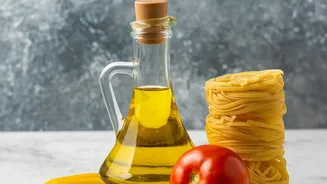
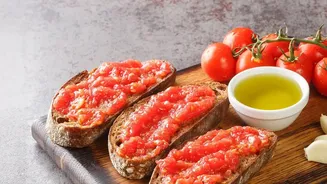
Bringing a frisella back to life is a simple but essential ritual. The classic preparation involves a quick dip in a bowl of water for a few seconds. Once softened, it is placed on a plate and traditionally topped with the essence of the Mediterranean: fresh, chopped cherry tomatoes, a generous drizzle of high-quality extra virgin olive oil, a sprinkle of salt, and a pinch of dried oregano. Letting it sit for a few minutes allows the bread to absorb the juices. While this classic tomato topping is most common, variations are endless, ranging from avocado and cheese to cured meats and marinated vegetables.