






The Grand Ambition: Gaganyaan
The Gaganyaan programme is the Indian Space Research Organisation's (ISRO) monumental endeavour to send a crew of three astronauts into a 400-kilometre orbit for a three-day mission and bring them safely back to Earth. This project would make India only
the fourth country in the world—after the United States, Russia, and China—to possess independent human spaceflight capability. The mission is not just about national prestige; it represents a significant leap in India's technological and scientific prowess, paving the way for future projects like a national space station. The launch vehicle for this historic mission is a human-rated variant of the powerful LVM3 rocket, specially modified to meet the stringent safety standards required for carrying a crew.
The Crucial Test: Validating the Escape and Recovery Systems
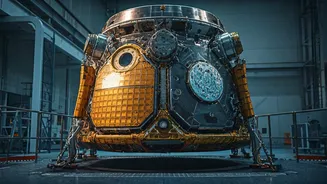
The headline-making test is not a single event but a sequence of crucial validations, with the Integrated Air-Drop Test (IADT) being a cornerstone. These tests are designed to prove the reliability of two of the most critical phases of any human mission: what happens if something goes wrong during launch, and how the crew gets home safely. Before astronauts ever board the capsule, ISRO must be certain that the Crew Escape System (CES) and the parachute-based deceleration system work flawlessly. The CES is an emergency mechanism designed to rapidly pull the crew module away from the rocket in case of a malfunction on the launch pad or during ascent. The parachute system is just as vital, as it's responsible for slowing the crew module from high velocity to a gentle splashdown in the ocean upon return.
Anatomy of a Safety Test
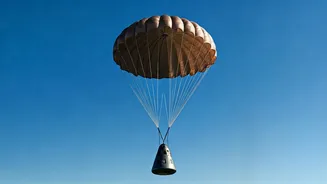
The Integrated Air-Drop Test simulates the final moments of the Gaganyaan mission. In a recent test conducted in April 2026, a simulated crew module weighing around 5.7 tonnes was lifted by an Indian Air Force Chinook helicopter to an altitude of about 3 kilometres and then released over the sea. From there, a complex, automated sequence of ten parachutes of four different types deployed precisely to slow the module's descent. This included drogue parachutes for initial braking, followed by pilot chutes that extract the three massive main parachutes, ensuring the module lands at a safe velocity. Other demonstrations, like the Pad Abort Test, prove the Crew Escape System's ability to fire its quick-acting motors and pull the capsule to safety in seconds if an emergency occurs before liftoff.
Why This is Non-Negotiable
In human spaceflight, there is no margin for error. The launch and re-entry phases are statistically the most dangerous parts of any mission. The entire Gaganyaan program operates on the principle of ensuring astronaut safety above all else. ISRO has conducted thousands of ground tests and simulations, but there is no substitute for real-world demonstrations of these life-saving systems. A series of uncrewed test flights are planned to validate the entire mission profile from launch to recovery. The first of these, G1, will carry a humanoid robot named Vyommitra to collect data on life-support systems and flight conditions. Only after multiple successful uncrewed missions will ISRO grant clearance for the first crewed flight, H1, which is now anticipated in 2027.
The Road Ahead to 2027
With the successful completion of key parachute and escape system tests, ISRO is systematically ticking the boxes on its pre-flight checklist. The focus now shifts to the uncrewed orbital missions slated for 2026. These flights will test the human-rated LVM3 rocket's performance, the crew module's life support systems in the vacuum of space, re-entry dynamics, and sea recovery operations. Each successful test builds confidence and provides invaluable data, moving India closer to its goal. The four astronaut-designates—Prasanth Balakrishnan Nair, Ajit Krishnan, Angad Pratap, and Shubhanshu Shukla—continue their rigorous training as the hardware they will depend on is proven safe and reliable. These meticulous preparations underscore a core philosophy: India will fly its astronauts only when it is absolutely certain it can bring them home safely.