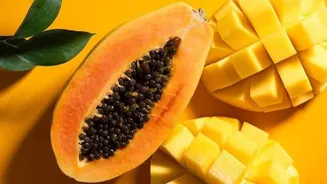








Mango and papaya are two of India’s most beloved fruits. Both are delicious and packed with nutrients, but a closer look at their nutritional profiles reveals key differences in sugar, fibre, and vitamins that can guide your choice.
The Calorie and Sugar Showdown
When it comes to managing
weight or sugar intake, papaya has a clear advantage. Per 100 grams, papaya contains roughly 43 calories and about 8 grams of sugar. In contrast, the same amount of mango has around 60 calories and nearly 14 grams of sugar. This makes papaya the lighter option, with approximately 43% less sugar than its sweeter cousin. For those on a low-carb diet or simply watching their calorie consumption, papaya offers more fruit for fewer calories and less sugar, making it a more suitable choice for weight management.
A Surprising Glycemic Index Twist
While mango is higher in sugar, the story gets more complex when we look at the glycemic index (GI), which measures how quickly a food raises blood sugar levels. Surprisingly, mango often has a lower GI, typically around 51, while papaya's GI is slightly higher, ranging from 56 to 59. This means that despite its higher sugar content, mango may cause a slower, more gradual rise in blood sugar. This is likely due to its specific sugar composition and fibre content. However, for both fruits, portion control is key, and pairing them with a source of protein or healthy fat can help blunt any blood sugar spikes.
The Fibre Focus
Fibre is essential for digestive health, promoting fullness and regular bowel movements. In this category, the race between mango and papaya is incredibly tight. Both fruits provide a good amount of dietary fibre, with most sources showing a near-tie. Per 100 grams, mango offers about 1.6 grams of fibre, while papaya provides around 1.7 grams. This difference is negligible, meaning both fruits are excellent choices for boosting your daily fibre intake and supporting a healthy gut. Raw mango, in particular, is noted for its insoluble fibre, which adds bulk, while papaya's fibre is often described as balanced for promoting digestion.
The Vitamin Verdict
Both mango and papaya are vitamin powerhouses, but they excel in different areas. Papaya is a clear winner for vitamin C, offering about 61 mg per 100 grams, which is nearly 70% more than the 36 mg found in mango. One cup of papaya can provide almost your entire daily requirement of vitamin C, making it a fantastic choice for immune support. On the other hand, mango is richer in vitamin A, folate, and vitamin E. Mango’s high vitamin A content, largely from beta-carotene, is crucial for eye health and skin cell turnover.
Unique Health_Boosting Compounds
Beyond the standard vitamins and minerals, each fruit boasts a unique compound that sets it apart. Papaya's claim to fame is papain, a powerful proteolytic enzyme. Papain helps break down proteins, aiding digestion and reducing symptoms like bloating and constipation. This is why papaya is often recommended after a heavy meal. Mango contains mangiferin, a potent antioxidant polyphenol studied for its anti_inflammatory, anti_diabetic, and heart_protective properties. While papain offers immediate digestive benefits, mangiferin works at a cellular level to combat oxidative stress over the long term.
The Final Slice: Which Fruit Is for You?
Ultimately,, neither fruit is 'bad' for you.. The 'better' choice depends entirely on your personal health goals.. If you're focused on weight loss,, managing blood sugar,, or need a digestive aid,, papaya's lower calorie and sugar content,, combined with the enzyme papain,, make it an ideal pick.. If you're looking to boost your vitamin A intake for better eye and skin health,, need a source of folate,, or want the anti_inflammatory benefits of mangiferin,, then mango is the superior option.. Both fruits offer valuable fibre and a host of vitamins,, reinforcing their status as healthy additions to any diet.