




The Science of Microwave Cooking
To understand the turntable, you first have to understand how a microwave heats food. It’s not like a conventional oven that heats the air around the food. Instead, a microwave oven uses, well, microwaves—a type of electromagnetic wave. A component called
a magnetron generates these waves, which flood the inside of the oven. These waves cause certain molecules in your food, primarily water, to vibrate rapidly. This intense molecular friction is what creates heat, warming your meal from the inside out, to an extent. But this process isn't perfectly uniform. The energy doesn't just spread out evenly like light from a bulb; it behaves in a much more complex way.
The Problem of Hot and Cold Spots
The inside of your microwave is a metal box. When the microwaves are generated, they bounce off the reflective metal walls. As these waves reflect and interact with each other, they create an interference pattern. This results in what physicists call “standing waves”—fixed areas where the wave energy is very strong (antinodes) and other areas where it is very weak or non-existent (nodes). These fixed patterns are what cause hot spots and cold spots. If your food were to remain stationary, the parts sitting in an antinode would get cooked (or overcooked), while the parts sitting in a node would remain cold. You can see this for yourself by removing the turntable, covering a plate with a layer of marshmallows, and heating it for about 50 seconds; you'll see some marshmallows puff up in the hot spots while others remain unchanged.
The Turntable's Simple, Brilliant Solution
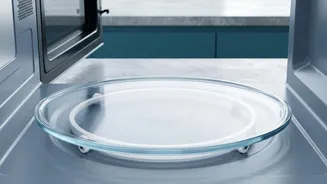
This is where the turntable comes in. Its job is elegantly simple: to move the food through those stationary hot and cold spots. By constantly rotating, the turntable ensures that every part of your meal gets a more even dose of microwave energy over the course of the cooking time. It physically carries the food from the high-energy antinodes to the low-energy nodes and back again, averaging out the exposure. Early microwaves actually didn't have turntables. Some used a hidden, fan-like device called a “mode stirrer” to try and bounce the microwaves around more randomly, but this solution wasn't always effective for larger or oddly shaped dishes. The turntable proved to be a more reliable mechanical fix for the masses.
What About Microwaves Without Turntables?
You may have seen modern microwaves that don't have a turntable at all. These are known as flatbed microwaves. They solve the uneven heating problem differently. Instead of moving the food, they move the microwaves. These models have a rotating antenna hidden beneath the flat floor of the oven cavity. This antenna distributes the microwave energy throughout the cooking space, eliminating the need for the food to physically rotate. The main advantages are more usable space—you can fit large, rectangular dishes without them getting stuck—and easier cleaning thanks to the smooth, continuous surface.
Tips for More Even Heating
Even with a turntable, you can help your microwave do its job better. Instead of piling food in the center of the plate, arrange it in a ring shape, leaving the middle empty. This allows the microwaves, which tend to heat from the outside in, to cook the food more evenly. For soups, stews, or casseroles, stirring the food halfway through the cooking time is crucial for redistributing heat. It's also wise to let your food rest for a minute or two after the microwave stops. This is called “standing time,” and it allows the heat to continue to conduct from the hotter areas to the cooler ones, resulting in a more uniform temperature throughout your meal.