






Just How Slow Is 'Too Slow'?
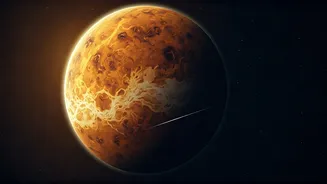
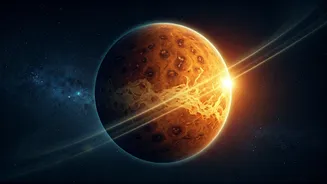
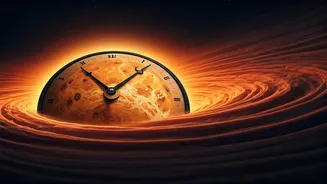
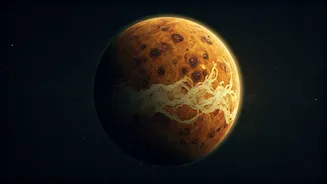
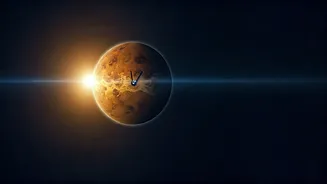
Imagine a day that stretches on for longer than a year. That’s not science fiction; it’s reality on Venus. While Earth completes a rotation in 24 hours, Venus takes a staggering 243 Earth days to spin once on its axis. To make things even stranger, it only
takes Venus 225 Earth days to orbit the Sun. This means a Venusian day is longer than a Venusian year. If you could stand on its surface, you’d see the Sun rise, but you’d have to wait over eight Earth months for it to set and rise again. This leisurely pace is completely out of sync with every other planet in our solar system, which all have days that are a tiny fraction of their years. This profound sluggishness has made Venus a long-standing cosmic puzzle for astronomers.
The Breakthrough Radar Measurements
For decades, scientists had estimates for Venus's rotation, but the numbers were frustratingly imprecise. Its thick, featureless clouds make it impossible to track surface landmarks from orbit. But a groundbreaking study, using 15 years of radar data, finally pinned it down. Between 2006 and 2020, scientists from UCLA used NASA's Goldstone Solar System Radar in the Mojave Desert to bounce radio waves off Venus. By analysing the faint echoes that returned to Earth, they could measure the planet's spin with pinpoint accuracy. The technique works like a disco ball: as Venus rotates, different surface features—invisible to the eye but detectable by radar—reflect the signal back. The slight shifts in these returning signals allowed researchers to calculate not just the precise length of the day (down to the millisecond) but also the exact tilt of its axis and even the size of its core.
A Planet Pushed by Its Own Atmosphere
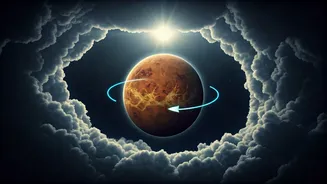
So, why does Venus spin so slowly and in the opposite direction to most other planets (a phenomenon known as retrograde rotation)? The leading theory points to its hellish atmosphere. Venus is smothered in a dense blanket of carbon dioxide that is 90 times thicker than Earth’s atmosphere, creating a runaway greenhouse effect and surface temperatures hot enough to melt lead. This thick atmosphere also 'super-rotates', whipping around the planet at speeds of over 300 km/h—60 times faster than the planet itself is spinning. This creates an enormous amount of friction and momentum. Scientists believe this colossal atmospheric tide acts like a constant brake on the solid planet, slowing its rotation and exchanging momentum between the surface and the air. The new, precise measurements of the planet’s wobble, or 'precession', strongly support this idea of a powerful atmospheric-solid body coupling.
A Glimpse Into the Core
The radar study didn't just look at the surface; it offered our best look yet into the planet's heart. Just as spinning a raw egg feels different from spinning a hard-boiled one, the way Venus wobbles on its axis gives away clues about what’s inside. The precise measurements of its spin and wobble allowed scientists to calculate the size of its metallic core for the first time. The findings suggest Venus has a core roughly 3,500 kilometres across, similar in size to Earth's. However, researchers are still unsure whether it's liquid or solid. Knowing the state of the core is crucial for understanding how the planet generates (or, in Venus’s case, fails to generate) a magnetic field, which is vital for protecting a planet from solar radiation.
Why This Cosmic Puzzle Matters
Solving the mystery of Venus's slow spin isn't just about satisfying curiosity. It provides a crucial window into how planets evolve. Venus is often called Earth’s 'evil twin' because it’s similar in size and mass, but took a radically different path. Understanding the powerful influence of its atmosphere on its very rotation helps us model how planetary climates and geology are linked. This knowledge is not only vital for understanding the history of our own solar system but also for identifying potentially habitable exoplanets in other star systems. If an Earth-sized planet can be so dramatically altered by its atmosphere, it tells us what to look for—and what to be wary of—in our search for life elsewhere in the universe.