




A Faster, More Mature Early Universe
For years, the story of the early universe was one of slow, chaotic assembly. Astronomers believed the first galaxies were small, messy collections of stars that gradually became more organized over billions of years. But recent observations, primarily
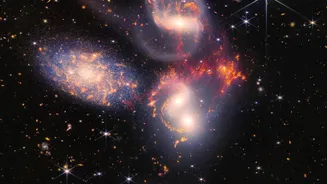
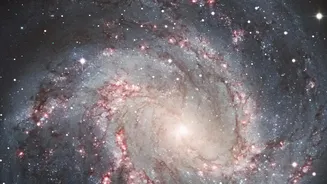
from the James Webb Space Telescope (JWST), are painting a different picture. These new, incredibly detailed images show galaxies in the universe's infancy—just a few hundred million years after the Big Bang—that are surprisingly mature and structured. This unexpected maturity is forcing a major rethink of cosmic evolution, suggesting that the processes that build galaxies got started much earlier and worked more efficiently than models had predicted.
Cosmic Engines Already at Work
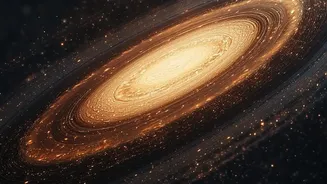
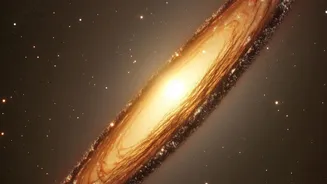
One of the most significant recent discoveries comes from a team at Durham University, who used JWST to look back more than nine billion years. They found the most distant example ever of a 'nuclear disc'—a dense, rotating hub of star formation at the heart of a galaxy. These structures are common in modern galaxies but were thought to be a product of later evolution. Crucially, this disc appears to have been built by a stellar bar, a long structure of stars that acts like a cosmic conveyor belt, funneling gas and dust to the center to fuel star birth. Finding a stellar bar and a nuclear disc so early suggests that galaxies didn't just drift into their shapes; they had internal engines that drove organized growth from a very young age.
The Fuel for the First Stars
A key question has always been how these early galaxies grew so big, so fast. It was suspected they had enormous reservoirs of fuel for star formation, but direct evidence was missing. Now, astronomers have found it. By studying a massive, star-forming galaxy called REBELS-25, seen when the universe was only about 700 million years old, scientists detected a huge supply of cold molecular gas—the direct ingredient for making stars. This discovery confirms that the raw materials for rapid star birth were abundant in the early cosmos, allowing some galaxies to bulk up much more quickly than once thought. This rapid growth helps explain why Webb is seeing so many surprisingly bright and large galaxies in its deep-field images.
Rewriting Our Own Galaxy's History
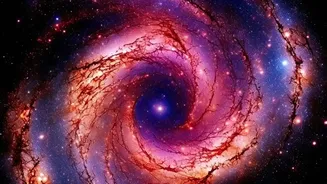
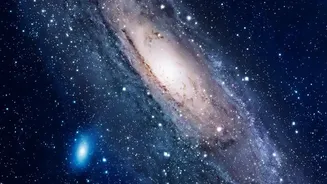
This new understanding of the distant past also sheds light on our own cosmic home, the Milky Way. Other recent research suggests our galaxy's history was more dramatic than we knew. Supercomputer simulations indicate that a massive, head-on collision with another galaxy, known as Gaia-Sausage-Enceladus, about 10 billion years ago may have caused the entire disc of the Milky Way to flip its orientation. This event helps explain some of the Milky Way’s unusual features, like the slow rotation of its stellar halo—a sparse sphere of ancient stars surrounding the main disc. It shows that galaxy evolution is not always a gentle process but can be shaped by violent, transformative mergers that set the stage for billions of years of subsequent development. By studying both nearby galaxies like Andromeda and the most distant ones at the dawn of time, scientists are assembling a more complete and dynamic timeline of the cosmos.