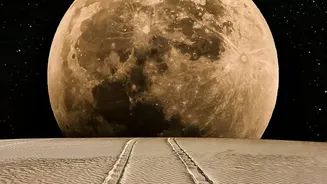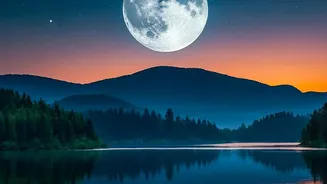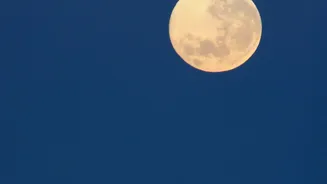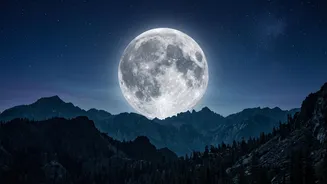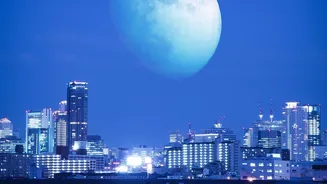

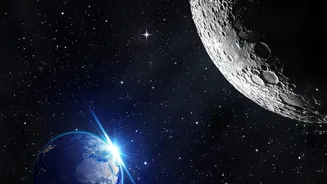
It’s a sight everyone knows: a colossal, golden moon rising over a distant treeline, looking close enough to touch. Hours later, it’s a small, white disc in the vastness of the sky. But what if it never actually changed size at all?
An Illusion as Old as Stargazing
The feeling that the
Moon is enormous when it’s near the horizon and shrinks as it climbs higher is one of the oldest and most powerful optical illusions known to humanity. It's been documented for thousands of years, puzzling everyone from ancient Greek philosophers to modern-day scientists. But here’s the spoiler: it’s all in your head. If you were to take a picture of the low-hanging Moon and another when it's directly overhead—using the same camera settings—the Moon would be the exact same size in both photos. In fact, due to the geometry of your position on a curved Earth, the Moon is technically about 4,000 miles (or 1.5%) farther away when it's on the horizon than when it's at its zenith, meaning it should appear ever so slightly smaller, not larger. This proves the 'Moon illusion' is entirely a product of perception, a glitch in how our brains process the world.
It's Not the Atmosphere's Fault
A common first guess for this phenomenon is that Earth's atmosphere acts like a magnifying glass, bending the light to enlarge the Moon's image. While the atmosphere does have an effect, it’s not magnification. When the Moon is low, its light travels through a much thicker slice of atmosphere to reach your eyes. This long path scatters more of the shorter, blue wavelengths of light, which is why the horizon Moon often appears a warm yellow, orange, or red. The atmosphere can also cause a slight 'squashing' effect, making the Moon look a bit flattened, but it does not make it appear bigger overall. The beautiful color of a rising moon is a real physical effect; the size is not.
The Brain’s Faulty Logic
The leading explanation for the Moon illusion is known as the 'apparent distance hypothesis', which is related to a classic trick of the mind called the Ponzo illusion. Imagine two identical lines drawn on a set of railroad tracks converging toward the horizon. The line drawn 'farther away' (where the tracks are closer together) will appear much longer than the identical line drawn 'closer' to you. Your brain uses the converging lines as depth cues, and it makes an assumption: if two objects take up the same space in my vision, but one is clearly farther away, the farther one must be physically larger. The Moon illusion works on the same principle. When the Moon is on the horizon, it’s surrounded by familiar objects that provide a sense of scale and distance: trees, buildings, and mountains. Your brain sees these objects and registers the scene as being very far away. Because the Moon is 'in' that distant scene, your brain scales it up, making it seem enormous to compensate for the perceived distance.
Losing Context in an Empty Sky
Once the Moon climbs high into the night sky, all that context disappears. It’s no longer anchored to the landscape. Instead, it floats in a vast, featureless expanse of black. Without trees or buildings to compare it to, your brain lacks the necessary cues to judge its distance. Our minds perceive the overhead sky as being much 'closer' than the distant horizon. Since the Moon overhead takes up the same amount of space in your field of view (about half a degree of arc), but your brain now perceives it as being closer, it concludes that the Moon must be smaller. It’s the same object, but any radical change in context tricks your brain into making two completely different size judgments.
Why Cameras Aren’t Fooled
A camera, unlike the human brain, is a simple machine for recording light. It has no learned assumptions about perspective, no lifetime of experience looking at landscapes, and no subconscious desire to make sense of depth cues. A camera lens simply captures the angular size of any object in its field of view. As long as any zoom isn't changed, any Moon will create exactly same sized image on any camera sensor whether it is sitting on any mountaintop or hanging high in any sky. Photographers can, however, recreate any illusion by using any powerful telephoto lens. By standing very far away from any foreground object (like any building or person) and zooming in, they can make that distant object appear small while any Moon remains its normal size.