




The Blueprint for the Universe
For decades, scientists have operated with a standard blueprint for the universe, known as the Lambda-Cold Dark Matter (Lambda-CDM) model. This model has been remarkably successful at explaining everything from the afterglow of the Big Bang (the cosmic
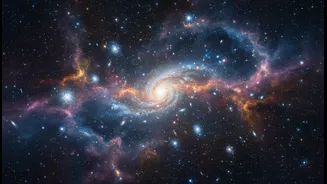
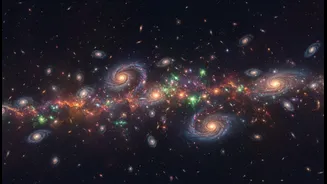
microwave background) to the way galaxies cluster together. A key part of this blueprint is the Cosmological Principle, which states that on the very largest scales, the universe is basically uniform and the same in all directions. Think of it like looking at a sandy: up close, you see individual grains and patterns, but from a great height, it all smooths out into a uniform expanse. Scientists believed that beyond a certain cosmic distance, the clumpy web of galaxies and voids would average out into a smooth, predictable pattern.
A Discovery Too Big to Ignore
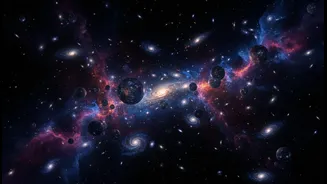
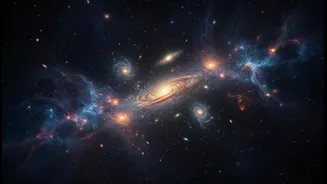
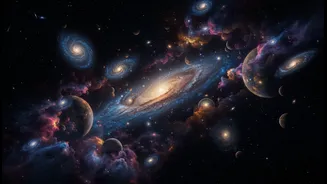
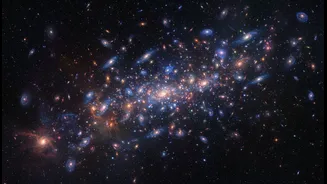
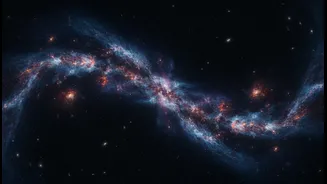
Recently, however, this tidy picture has been thrown into disarray. Astronomers have discovered colossal structures in the early universe that are simply too big to exist according to the standard model. One of the most stunning examples is the 'Big Ring', a gigantic arrangement of galaxies and clusters measuring 1.3 billion light-years in diameter. To put that in perspective, our own Milky Way galaxy is about 100,000 light-years across. The Big Ring is so vast that light would take over a billion years to travel from one side to the other. Its discovery, led by researcher Alexia Lopez, challenges the theoretical size limit for any structure in the cosmos, which cosmologists calculated to be around 1.2 billion light-years. Structures larger than this shouldn't have had enough time to form since the Big Bang.
Cosmic Neighbors and Lingering Questions
What makes the Big Ring even more baffling is that it’s not alone. In 2021, the same team discovered another, even larger formation called the 'Giant Arc', which spans an incredible 3.3 billion light-years. Astonishingly, these two behemoths are cosmic neighbors, located at the same distance from Earth and appearing close to each other in the sky. "We could expect maybe one exceedingly large structure in all our observable universe," Lopez noted. Finding two, so close together, suggests this may not be a random fluke. These discoveries, along with others made by instruments like the James Webb Space Telescope (JWST), are forcing a major rethink. The JWST has consistently found that the early universe was far more complex and structured than models predicted, with massive galaxies forming much earlier than thought possible.
Rewriting the Rules of the Cosmos
So, what does this all mean? These mega-structures directly challenge the Cosmological Principle, the idea that the universe is uniform on its largest scales. If the universe isn't as smooth as we thought, then the fundamental model used to describe it might be incomplete. Scientists are now scrambling to figure out what's going on. Some theories suggest the structures could be related to phenomena like Baryonic Acoustic Oscillations (BAOs)—fossil sound waves from the early universe—but the Big Ring and Giant Arc don't quite fit the expected shape or size. Other, more exotic explanations, such as the influence of cosmic strings (hypothetical defects in spacetime), are being considered. There's also immediate pushback and debate within the scientific community, with some researchers arguing the structures might be statistical illusions or that the standard model can accommodate them with tweaks.