



The World's Chief Diplomat
The Secretary-General is often called the world's top diplomat and the chief administrative officer of the United Nations. Their role is a delicate balance of public advocacy, behind-the-scenes diplomacy, and managing a sprawling global bureaucracy. The UN
Charter empowers them to bring matters threatening international peace and security to the Security Council's attention. With António Guterres's second and final five-year term ending on December 31, 2026, the race to find his successor is well underway, shining a light on a procedure that is part election, part geopolitical chess match.
A Two-Stage Process
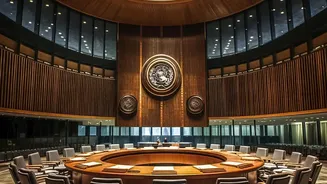
On paper, the selection is straightforward. Article 97 of the UN Charter states that the General Assembly appoints the Secretary-General upon the recommendation of the Security Council. This creates a two-step system. First, the 15-member Security Council must agree on a single candidate to recommend. Then, the 193-member General Assembly gives its final, formal approval. While the General Assembly's vote is essential, it has never rejected the Security Council's recommended candidate, making the Council's decision the most critical stage.
Secret Ballots and Straw Polls
The real drama unfolds behind the closed doors of the Security Council. To gauge support for various candidates, the Council holds a series of informal secret ballots known as 'straw polls'. In these polls, members vote to either 'encourage' or 'discourage' a candidate, or they can offer 'no opinion'. These initial polls are designed to test the viability of candidates without forcing a formal, binding vote. As the process continues, later rounds of straw polls use colour-coded ballots: the five permanent members (P5) vote on one colour, and the ten non-permanent members vote on another. A 'discourage' vote on a coloured ballot from a P5 nation—China, France, Russia, the United Kingdom, and the United States—is effectively a veto threat.
The Power of the Veto
The most significant power in the selection process is the veto held by the P5. Any one of these five countries can block a candidate, regardless of how much support they have from the other 14 Council members. This means the successful candidate must be acceptable to all five permanent members. This requirement often leads to extensive negotiations and can favor candidates who are seen as least likely to challenge the interests of the major powers. As of late November 2026, several straw polls have been conducted for the current selection, but no candidate has yet emerged without receiving 'discourage' votes from P5 members, indicating the difficulty of finding a consensus choice.
A Push for Transparency
Historically, the selection process was almost entirely shrouded in secrecy. However, starting with the 2016 selection, a significant push for more openness has changed some aspects of the procedure. For the first time, member states formally nominated candidates, who then submitted vision statements and participated in public, webcast dialogues with the General Assembly. This allowed for unprecedented engagement from the global public and civil society. While these reforms have made the early stages more transparent, the crucial final decision-making within the Security Council, including the straw polls and the threat of the veto, remains a fundamentally opaque process.
The 2026 Race Heats Up
The race to become the tenth Secretary-General is currently a competitive field with several experienced diplomats and international civil servants in contention. As of mid-November 2026, eight candidates are actively campaigning. The ongoing straw polls have shown shifting support, with no single frontrunner securing a clear, veto-proof path to the nomination. The lack of consensus so far highlights the deep geopolitical divisions and the difficulty of finding a candidate palatable to all major world powers, raising concerns that the selection process could face a deadlock as the year-end deadline approaches.