
The Ultimate Earth-Independent Resource
For decades, launching anything into space has been governed by a simple, brutal equation: weight is everything. Every kilogram sent from Earth to the Moon costs an immense amount of money and fuel. To build a sustainable presence, astronauts can't rely
on resupply missions from home for basic needs. This is why the discovery of water ice on the Moon was a game-changer. Water (H2O) is not just for drinking. Its components, hydrogen and oxygen, are the primary ingredients in rocket propellant. By harvesting lunar ice, a future Artemis Base Camp could effectively become a refueling station for missions deeper into the solar system, including Mars. It also provides breathable air (oxygen) and radiation shielding, making it the most critical resource for establishing a long-term economic and scientific foothold in space.
Why the South Pole is Prime Real Estate
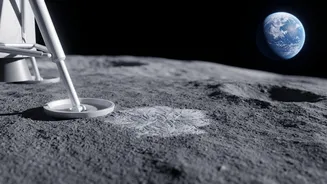
The Moon's South Pole is a land of stark contrasts. Because the Moon is tilted on its axis by only 1.5 degrees, the sun skims the horizon at a low angle. This creates peaks, like those on the rim of Shackleton Crater, that are in near-constant sunlight, perfect for generating solar power for a base. Just a short distance away, inside these deep craters, are Permanently Shadowed Regions (PSRs) where sunlight has not reached for billions of years. These are some of the coldest places in the entire solar system, and this extreme cold has acted as a perfect trap, preserving water ice delivered by comets and asteroids over eons. Missions like India's Chandrayaan-1 orbiter have provided data confirming the presence of this ice. This unique combination of constant sunlight for energy and deep darkness for ice makes the South Pole the most strategic location for a lunar settlement.
Hunting for Ice with Robotic Scouts
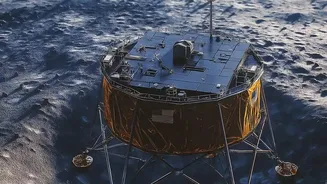
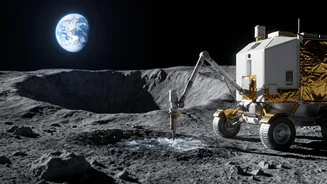
Before astronauts can start mining, NASA needs to know exactly where the best ice deposits are. That's the job of robotic explorers. The key mission for this task is NASA's Volatiles Investigating Polar Exploration Rover, or VIPER. This golf-cart-sized rover is designed to navigate the treacherous lunar terrain, even driving into the dark, frigid craters with headlights to guide it. VIPER is equipped with a one-meter drill to dig into the lunar soil, or regolith, and instruments to analyze how much water is present and in what form—for instance, as ice crystals or bound to minerals. After a cancellation in 2024 and subsequent revival, the mission is now slated to be delivered to the Moon's surface by Blue Origin in 2027. The data VIPER collects will create the first-ever resource maps of another celestial body, guiding future human and robotic missions to the most resource-rich locations.
How to Mine the Moon
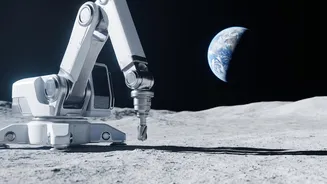
So how do you actually extract water from frozen lunar dirt? The process is called In-Situ Resource Utilization (ISRU), and NASA and its commercial partners are developing several technologies to do it. The basic concept involves excavating the ice-rich regolith and heating it inside a contained chamber. As the regolith heats up, the frozen water turns directly into vapor, a process called sublimation. This water vapor is then collected and condensed back into liquid water. One proposed method involves autonomous rovers using focused sunlight or microwave beams to heat the subsurface without major excavation. This water can then be purified for drinking or passed through a process called electrolysis, which uses electricity from solar panels to split the water molecules into hydrogen and oxygen. These elements can be stored as liquid rocket fuel, creating a self-sustaining cycle for the lunar base.