

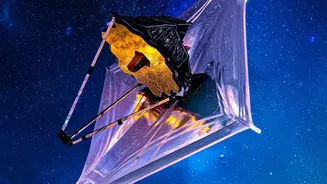

A Universe in Panoramic View
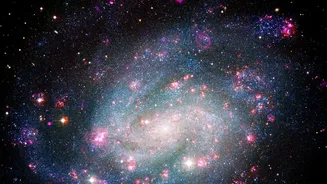
The defining feature of the Roman Space Telescope is its incredible field of view. While the Hubble and James Webb Space Telescopes (JWST) are designed to zoom in on specific cosmic targets with breathtaking detail, Roman is built to do the opposite:
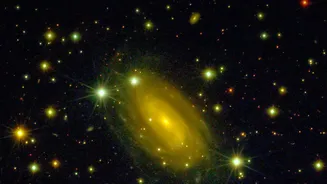
zoom out. Its Wide Field Instrument can capture an area of the sky at least 100 times larger than Hubble's infrared camera in a single snapshot, all with the same stunning resolution. This makes it an unparalleled survey telescope. In its initial five-year mission, Roman will observe 50 times more sky than Hubble has in over 30 years. This ability to rapidly create vast, high-resolution maps of the universe will provide a treasure trove of data, enabling scientists to study the cosmos on an unprecedented scale and identify new, intriguing targets for Hubble and Webb to investigate in more detail.
Shining a Light on Dark Mysteries
Two of the biggest puzzles in modern astrophysics are dark energy and dark matter. These invisible components are believed to make up about 95% of the universe, but their true nature remains unknown. Roman’s primary mission is to change that. It will investigate dark energy—the mysterious force causing the universe's expansion to accelerate—by surveying billions of galaxies and thousands of distant exploding stars called supernovae. By precisely measuring their distances and how they are distributed, scientists can trace the expansion history of the universe. At the same time, Roman will map the distribution of dark matter by observing its gravitational effects on the light from distant galaxies, a phenomenon known as weak gravitational lensing. This will help scientists understand how dark matter has shaped the formation of galaxies over cosmic time.
A New Frontier in Planet Hunting
While missions like Kepler and TESS have discovered thousands of exoplanets by watching for the dimming of starlight as a planet passes in front of its star (the transit method), Roman will primarily use a different and powerful technique: gravitational microlensing. This effect, predicted by Einstein, occurs when a star and its planet pass in front of a more distant background star. The gravity of the foreground star acts like a natural magnifying glass, brightening the light of the background star. A planet orbiting the lens star creates a second, brief spike in that brightness, revealing its presence. This method is especially sensitive to planets farther from their stars, from the habitable zone outwards, and even rogue planets that drift through space without a host star. Scientists expect Roman to discover thousands of new worlds this way, providing a more complete census of the planets in our galaxy.
A Telescope with a Spy-Tech Past
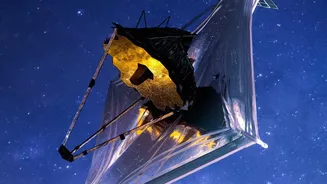
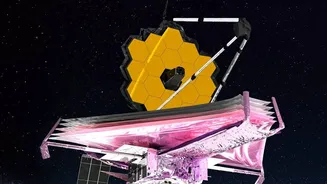
The heart of the Roman observatory is its 2.4-meter (7.9-foot) primary mirror, which is the same size as Hubble's. This mirror has a unique origin story: it was originally built for a spy satellite and was donated to NASA by the National Reconnaissance Office. In addition to its main Wide Field Instrument camera, Roman also carries a technology demonstration called the Coronagraph Instrument. This device is designed to block the overwhelming glare of a star, which could allow astronomers to directly image giant exoplanets orbiting nearby stars for the first time in reflected visible light. While it is an experimental instrument, its success will pave the way for future missions aimed at imaging Earth-like worlds.
The Journey to First Light
After a successful launch aboard a SpaceX Falcon Heavy rocket on August 30, 2026, the Roman Space Telescope began its journey to its operational orbit. It is traveling to the second Lagrange point (L2), a gravitationally stable spot about 1.5 million kilometers (930,000 miles) from Earth, where JWST also resides. This location provides an unobstructed view of the cosmos. The telescope is now undergoing a 90-day commissioning phase to test and calibrate its instruments. NASA expects to release Roman's first groundbreaking images to the public by early 2027, heralding a new era of cosmic discovery.