

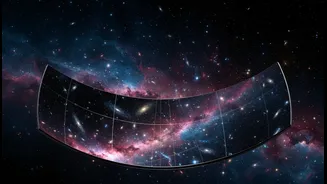
A New Window to the Universe
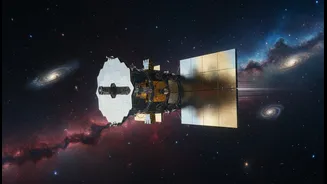
Set to launch by late 2026, the Nancy Grace Roman Space Telescope is NASA's next flagship astrophysics mission, poised to revolutionize our understanding of the cosmos. Named after Nancy Grace Roman, NASA’s first chief of astronomy, this observatory has
a mirror the same size as Hubble's but boasts a field of view 200 times larger. This vast panorama will allow it to map the universe with unprecedented speed and detail. Its primary goals are breathtaking: to hunt for thousands of new exoplanets, including rocky worlds and rogue planets that drift untethered to a star, and to tackle the profound mystery of dark energy, the enigmatic force causing the universe's expansion to accelerate. By surveying over a billion galaxies, Roman will create a 3D map of the cosmos, helping scientists understand the very fabric of space and time.
The Telescope's Digital Eyes
At the heart of this cosmic explorer is the Wide Field Instrument (WFI), which is essentially its primary camera. This isn't just any camera; it's a 300.8-megapixel marvel designed to capture faint infrared light from the most distant corners of the universe. The WFI is composed of 18 highly sensitive detectors that work together to create its enormous field of view. These detectors are so sensitive that they can spot a planet a billion times dimmer than its host star. But this sensitivity comes at a price: the instrument is extremely susceptible to heat and electronic interference, or 'noise'. Any extraneous heat or electronic hum could blind the telescope, washing out the faint whispers of light from ancient galaxies it's designed to see.
A Trial by Fire and Ice
To ensure the WFI would perform flawlessly a million miles from Earth, engineers had to first subject it to hell on the ground. This involved a series of intense environmental tests designed to simulate both the violence of a rocket launch and the unforgiving cold of deep space. In a massive thermal vacuum chamber, the instrument was cooled to cryogenic temperatures, mirroring the conditions it will experience in its orbit at the second Lagrange point (L2). It was also blasted with sound and shaken violently to ensure it could withstand the journey off-planet. These tests are nerve-wracking but absolutely critical; there are no repair calls in deep space, so everything must work perfectly from the start.
Hunting for an Electronic Ghost
One of the most crucial trials was the electromagnetic interference test. Engineers powered up all of the WFI’s complex electronics inside a specially designed chamber that blocks all external radio signals. Their goal was to listen for the instrument’s own electronic hum. They needed to confirm that none of the components were generating stray signals that could interfere with others or, even worse, with the detectors themselves. Think of it as trying to record a whisper in a library; even the quietest hum from a light fixture can ruin the recording. For Roman, that 'hum' could be the difference between a groundbreaking discovery and a blurry, useless image. The instrument passed with flying colors, proving its electronic systems were as quiet and stable as designed.