



A World of Ice and Colour
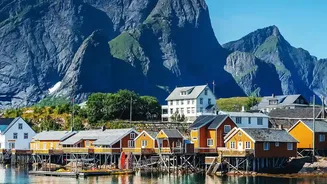
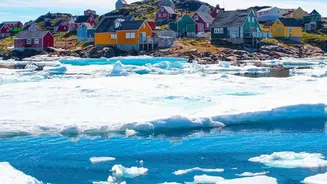
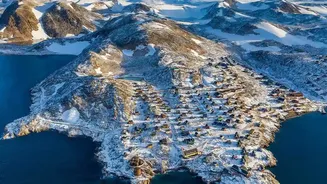
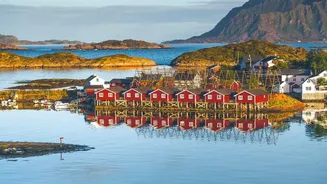
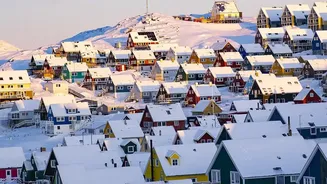
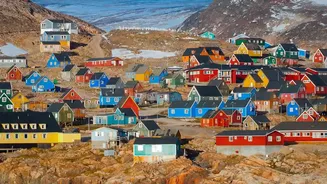
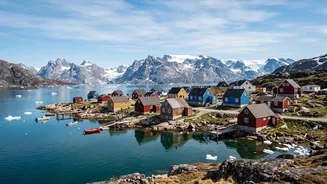
The first thing that strikes any visitor to a Greenlandic village is the brilliant contrast of colour against the pristine white and deep blue of the Arctic. Rows of wooden houses, painted in bold reds, blues, greens, and yellows, cling to rocky hillsides
overlooking the water. This tradition, which began in the colonial era, once served as a practical colour-coding system: red for churches or trade, yellow for hospitals, blue for fish factories, and so on. While homeowners are now free to choose any colour they wish, the practice has left a legacy of vibrant, picturesque communities that seem to glow against the snow and ice. Towns like Ilulissat, Qaqortoq, and the capital, Nuuk, are famous for these colourful vistas, where every street offers a new, striking composition of human life nestled within an immense natural world.
The Sound of Deep Silence
Perhaps more profound than the visual splendour is the soundscape—or lack thereof. The near-total absence of roads connecting settlements means there is no hum of distant traffic. Instead, the silence is deep and palpable, broken only by the natural sounds of the Arctic. You might hear the gentle lapping of water against fishing boats, the distant cry of a seabird, or the collective howl of sled dogs settling in for the evening. This quiet allows other, more subtle sounds to emerge: the crunch of footsteps on snow, the whistle of wind across a frozen fjord, and the ghostly creaks and groans of icebergs shifting in the harbour. This is not an empty silence but a full one, an environment that invites contemplation and a deep sense of peace.
Life by the Water's Edge
Life in these villages is inextricably linked to the sea. Harbours are the heart of the community, bustling with small fishing boats that provide sustenance and livelihood. For centuries, fishing and hunting have been central to the Greenlandic way of life, a tradition that continues today alongside modern conveniences. In summer, kayaks glide through the icy waters, and in winter, when the fjords freeze over, dog sleds and snowmobiles become essential modes of transport to reach traditional fishing grounds. The harbour is a place of work, of departure, and of return—a constant reminder of the powerful connection between the people and the ocean that surrounds them.
Giants of Ice Adrift
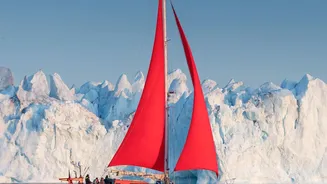
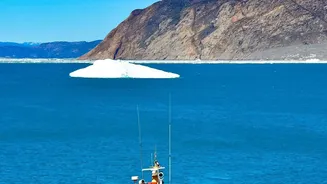
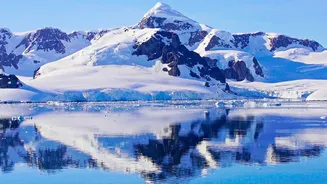
In many coastal towns, particularly Ilulissat which sits at the mouth of a UNESCO World Heritage-listed icefjord, the most dramatic feature is the constant parade of icebergs. Calved from some of the world's most active glaciers, these colossal sculptures of ice drift slowly through the fjords and out into Disko Bay. Some are the size of small buildings, others as large as city blocks, their shapes constantly changing as they melt and fracture. They fill the horizon, their brilliant white and deep blue hues catching the unique Arctic light. Watching these frozen giants float silently past is a humbling experience, a powerful and beautiful display of nature's raw power.
A Resilient Community Spirit
Living in such a remote and challenging environment fosters a strong sense of community. With a small population scattered across a vast landscape, cooperation and mutual support are essential parts of daily life. Despite the isolation, there is a warmth to be found in these villages. It’s a place where neighbours know each other, traditions are cherished, and life moves at a more human pace. Visitors often speak of the welcoming nature of the Greenlandic people, who blend ancient Inuit traditions with modern living. This unique culture, born from a life lived in close harmony with an extreme environment, is as compelling as the landscape itself.