


A New Look at a Familiar Galaxy
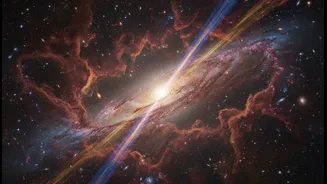
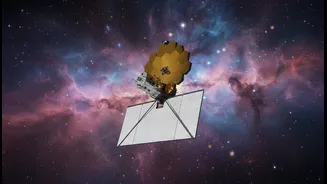
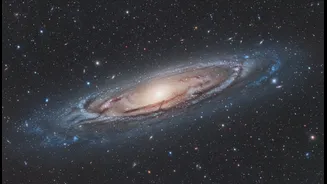
To mark the fourth anniversary of its science operations, the James Webb Space Telescope (JWST) has captured a stunning new portrait of Centaurus A. Located about 11 million light-years away, this galaxy is a favourite subject for astronomers, but Webb’s
infrared vision reveals it like never before. Where older telescopes saw only thick lanes of obscuring dust, Webb cuts through to reveal a packed field of millions of individual stars. This image is more than just a pretty picture; it's a work of 'galactic archaeology.' Scientists can now study these individual stars to piece together the galaxy's violent history, including a massive collision with another galaxy that happened about two billion years ago.
The Mysteries of Centaurus A
The new images from Webb's Mid-Infrared Instrument (MIRI) highlight the galaxy's strange and beautiful dust structures. Astronomers are particularly intrigued by a warped, parallelogram-shaped band of dust at the galaxy's core and a strange S-shaped feature. These unusual formations raise new questions about the supermassive black hole at the galaxy's center. This black hole is actively feeding on gas and dust, blasting out powerful jets of energy that shape the entire galaxy. The images help scientists study the complex interplay between a galaxy and the giant black hole at its heart, offering clues to how they grow and evolve together.
A Cosmic Firework Display
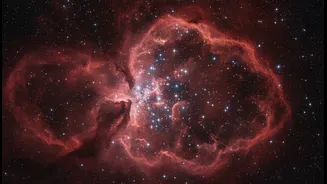
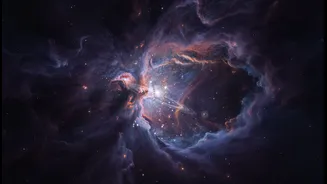
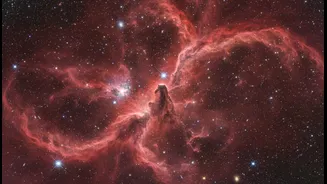
Another recent image, this time from the Hubble Space Telescope, brings us closer to home. It shows a stellar nursery called LH 95, located in the Large Magellanic Cloud, a dwarf galaxy that orbits our own Milky Way. The image is a dazzling display of colour, with brilliant blue and white stars sparkling against a backdrop of glowing crimson hydrogen gas. This nursery is home to thousands of infant stars, including massive blue giants that are shaping their environment with powerful radiation and stellar winds. The red glow of the gas is a clear sign of active star formation, allowing astronomers to spot the youngest stars as they begin their cosmic journey.
The Universe's Oldest Light
Pushing the boundaries of observation, ESA's Euclid mission has recently discovered what is believed to be the most ancient quasar ever seen. Quasars are incredibly bright and distant objects powered by supermassive black holes at the centers of young galaxies. Finding them helps astronomers understand the early universe. While not a colourful image in the traditional sense, this discovery is a significant look back in time. The Euclid telescope is on a mission to map the large-scale structure of the universe, and uncovering these ancient beacons provides crucial information about how the first galaxies and black holes formed just a few hundred million years after the Big Bang.
A Deep Dive into Our Own Galaxy
In a special observation, the Euclid telescope also turned its gaze toward the crowded center of our own Milky Way galaxy. The result is the largest and most detailed high-resolution photo ever taken of our galaxy's heart in visible light, packed with over 60 million stars. This incredibly sharp image allows astronomers to distinguish individual stars in a region so dense it often appears as a single blur. The data is so valuable that it will help in the search for exoplanets, using a technique where the light from a distant star is bent by the gravity of a closer star and its potential planets. It’s a stunning preview of what future telescopes will explore in even greater detail.