





Meet the Cosmic Sparkler
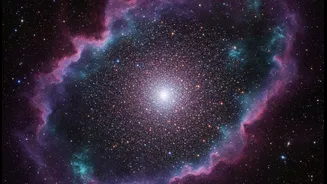
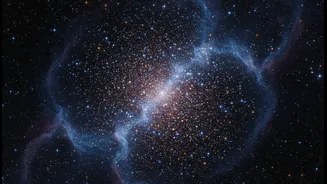
The subject of Hubble's latest portrait is a globular cluster, a spherical collection of ancient stars bound tightly by gravity. Specifically, the new image showcases NGC 6426, a cluster located in the outer halo of our Milky Way, some 67,000 light-years
from Earth. Globular clusters are like cosmic fossils; their stars are thought to have all formed from the same cloud of gas at roughly the same time, billions of years ago. NGC 6426 is estimated to be about 13 billion years old, making it one of the most ancient objects in our galaxy, nearly as old as the universe itself. This makes it a pristine laboratory for studying the early days of cosmic history.
The Puzzle of Multiple Generations
For a long time, astronomers believed the stars in a globular cluster were all part of a single, simple population—all born at once with the same chemical makeup. However, mounting evidence has challenged this idea. One of the biggest mysteries these clusters present is the presence of multiple stellar populations. Observations show that many clusters host at least two distinct groups of stars: a first generation with a chemical composition similar to other old stars in the galaxy, and a second generation that is uniquely enriched with certain elements and depleted of others. This new, incredibly sharp Hubble image of NGC 6426 provides compelling visual evidence of this phenomenon. It helps confirm that the cluster contains two chemically distinct populations, suggesting a more complex and dynamic history than previously thought. The second, younger generation of stars likely formed from material ejected by massive stars from the first generation that had already ended their lives.
Solving an Age-Old Problem
The different colours in the Hubble image are not just for show; they tell a scientific story. Blue tones represent hotter, more massive stars, while red tones indicate cooler, older, or less massive stars. By precisely measuring the colours and brightness of thousands of individual stars within the cluster, astronomers can untangle its history. For years, one puzzling feature in some clusters has been the appearance of 'blue stragglers'—stars that appear younger and hotter than their neighbours, seemingly reversing the ageing process. The incredible detail from Hubble allows astronomers to study the locations and properties of these stars, confirming the leading theories that they are formed by stellar collisions or by one star pulling material from a binary companion, giving them a new lease on life.
The Hunt for a Missing Link
The dense, crowded center of a globular cluster is an extreme environment, and a perfect hiding place for another cosmic mystery: intermediate-mass black holes (IMBHs). These objects, with masses between 100 and 100,000 times that of our sun, are the 'missing link' between the small black holes formed from single stars and the supermassive black holes found at the centers of galaxies. Their existence has been long debated. To find an IMBH, astronomers use Hubble to track the movements of stars near the cluster's core. An unseen, massive object will betray its presence through its gravitational tug on these stars. While this new image of NGC 6426 is still being analysed for such a signature, it is part of a broader Hubble survey specifically designed to hunt for these elusive black holes in the hearts of globular clusters, which are considered prime environments for IMBHs to form through the merger of stars.