


A Tale of Two Planets
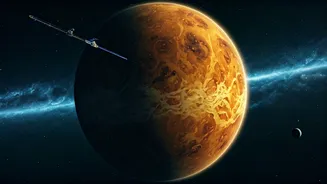
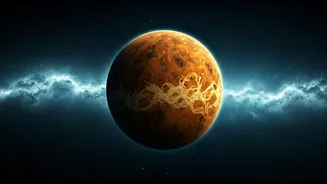
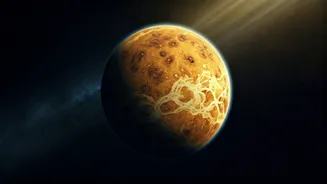
At first glance, Venus and Earth are remarkably similar. They are nearly the same size, mass, and density, and are made of similar rocky materials. Both planets formed in the same cosmic neighbourhood around the same time. For these reasons, Venus has
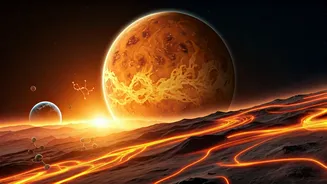
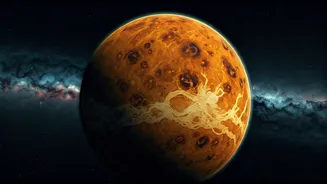
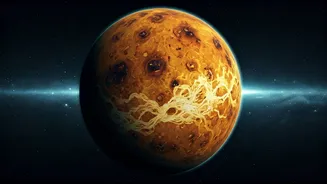
long been nicknamed Earth's twin. But this is a family resemblance that ends dramatically at the surface. While Earth became a haven for life, Venus devolved into the solar system's most hostile planet. Its surface temperature is a staggering 465 degrees Celsius, hot enough to melt lead, under an atmospheric pressure 90 times greater than Earth's. Its skies are perpetually shrouded in thick clouds of sulfuric acid. This stark difference is the central mystery that scientists, including those at ISRO, are desperate to solve.
The Runaway Greenhouse Warning
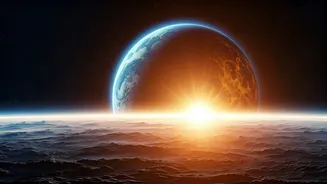
The prime suspect behind Venus’s hellish transformation is a phenomenon known as the runaway greenhouse effect. Its atmosphere is over 96% carbon dioxide, an incredibly efficient heat-trapping gas. Scientists believe that early in its history, Venus may have had liquid water oceans much like Earth. However, as the sun grew brighter, surface water evaporated, putting more water vapour (another greenhouse gas) into the atmosphere. This trapped more heat, causing more water to evaporate, creating a catastrophic feedback loop that boiled the planet's oceans away and baked its surface. For scientists on Earth, understanding this process isn't just academic. It serves as a large-scale, long-term case study for climate modeling, offering a cautionary tale about how dramatically a planet's climate can change.
ISRO's Next Frontier: Shukrayaan-1
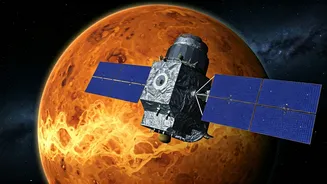
Enter Shukrayaan-1, ISRO's planned Venus Orbiter Mission. Following the historic successes of Chandrayaan (Moon) and Mangalyaan (Mars), this mission represents the next logical step in India's interplanetary exploration ambitions. The mission, whose name combines the Sanskrit words for Venus ('Shukra') and craft ('Yaana'), will place a 2500 kg spacecraft into an elliptical orbit around the planet. While a definitive launch date is pending final government approvals, optimal windows exist in 2026, 2028 and 2031, with 2028 currently being scheduled. This orbiter won't attempt the incredibly difficult task of landing on the surface but will instead use a powerful suite of instruments to peer through the clouds and study the planet from above.
A High-Tech Scientific Toolkit
The primary objective of Shukrayaan-1 is to create a comprehensive map of Venus's surface and subsurface geology and study its atmospheric chemistry. To do this, it will carry a host of sophisticated instruments. A key payload is a high-resolution Synthetic Aperture Radar (SAR), which can penetrate the dense cloud cover to image the surface features, looking for signs of active volcanoes and lava flows. The mission also plans to be the first-ever to use a ground-penetrating radar to study the shallow subsurface of Venus, giving us a look at its geological layers for the first time. Other instruments, some developed with international partners from Sweden, Germany, and France, will analyse the atmospheric composition, its super-rotating dynamics, and how it interacts with the solar wind without the protection of a global magnetic field.
India's Place in a New Space Race
ISRO is not alone in its renewed focus on Venus. NASA has two missions planned (VERITAS and DAVINCI), and the European Space Agency is developing its EnVision orbiter. Shukrayaan-1 positions India as a key player in this new wave of Venusian exploration. The mission is more than just a scientific endeavour; it's a testament to India's growing capabilities in designing and executing complex deep-space missions. By tackling the mysteries of Venus, ISRO will not only contribute vital data to the global scientific community but also inspire a new generation and solidify India's status as a major spacefaring nation. The quest to understand why Earth's twin took such a different path could ultimately help us better protect our own home.