




A Landmark Investment in Indian Robotics
Eka Robotics, a startup with roots at MIT, announced this week it has raised $150 million in a Series A funding round co-led by prominent venture capital firms Andreessen Horowitz (a16z) and F-Prime. This substantial investment catapults the company to
a valuation of over $1 billion, signaling immense investor confidence in its technology and market potential. A Series A round is typically the first significant round of venture capital financing a startup receives, and a sum of this magnitude is a powerful endorsement. It validates Eka's approach and provides the capital needed to scale its technology, expand its engineering teams, and begin commercial deployments with partners in manufacturing and logistics.
The Quest for Robotic Dexterity
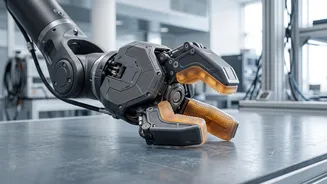
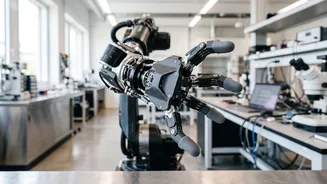
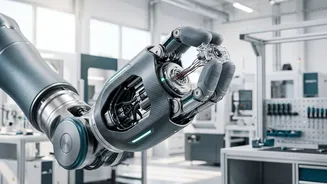
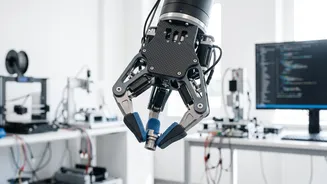
For decades, industrial robots have excelled at repetitive, high-force tasks like welding and lifting heavy parts on an assembly line. However, they have struggled with 'contact-rich' tasks that require a delicate touch—like plugging in a cable, picking a piece of fruit, or sorting a bin of diverse objects. This is the challenge of dexterity. Humans perform these tasks intuitively, constantly adjusting grip and pressure based on what we see and feel. Eka aims to give robots a similar 'intuition'. The company is developing a system that combines advanced vision, force sensors, and artificial intelligence, which it calls a vision-force-action (VFA) model. This allows the robot to build an understanding of physics, moving beyond simply mimicking human actions to truly interacting with its environment.
How Eka's Technology Works
Instead of being programmed for one specific task, Eka's robots learn in a simulated digital environment. Within this virtual world, the AI can practice handling objects millions of times in minutes, experiencing a vast range of shapes, weights, and textures. This process, known as reinforcement learning, allows the system to develop general principles about how to grasp and move things. When this learning is transferred to a physical robot arm equipped with a force-sensitive gripper, the machine can handle objects it has never encountered before with surprising accuracy and speed. Early results show Eka's robots can pick around 1,500 objects an hour with over 95% accuracy, more than double the rate of a human worker.
Transforming Indian Industries
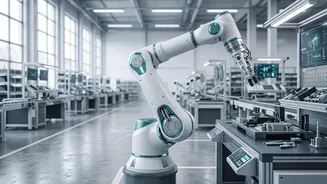
The applications for this technology in India are vast. The country's industrial robotics market was valued at over $2 billion in 2026 and is projected to grow significantly. In the booming e-commerce sector, dexterous robots could revolutionize warehouse and fulfillment centers, sorting and packing a wide variety of consumer goods. In electronics manufacturing—a key focus for India—these robots could perform the delicate assembly of small components. Other potential sectors include automotive, where robots could handle complex wiring tasks, and even agriculture for the gentle handling of produce. This leap in automation promises to boost productivity, improve quality, and enhance worker safety by taking over strenuous or hazardous jobs.
A Boost for 'Make in India'
Eka Robotics' success is part of a larger trend. Indian robotics startups are gaining global attention, with funding in the sector growing significantly in recent years. This progress aligns perfectly with national initiatives like 'Make in India', which aim to establish the country as a global manufacturing powerhouse. By developing and deploying advanced automation technologies domestically, companies like Eka can help Indian manufacturers become more competitive on the world stage. The development of such a sophisticated 'physical AI' model within the country represents a critical step in building a self-reliant, high-tech industrial ecosystem, moving India from a user of technology to a creator of it.